

 InfoSearched
Turning a discarded box cutter blade into a knife small enough to balance on a fingertip is the kind of build that only makes sense once you watch it happen.
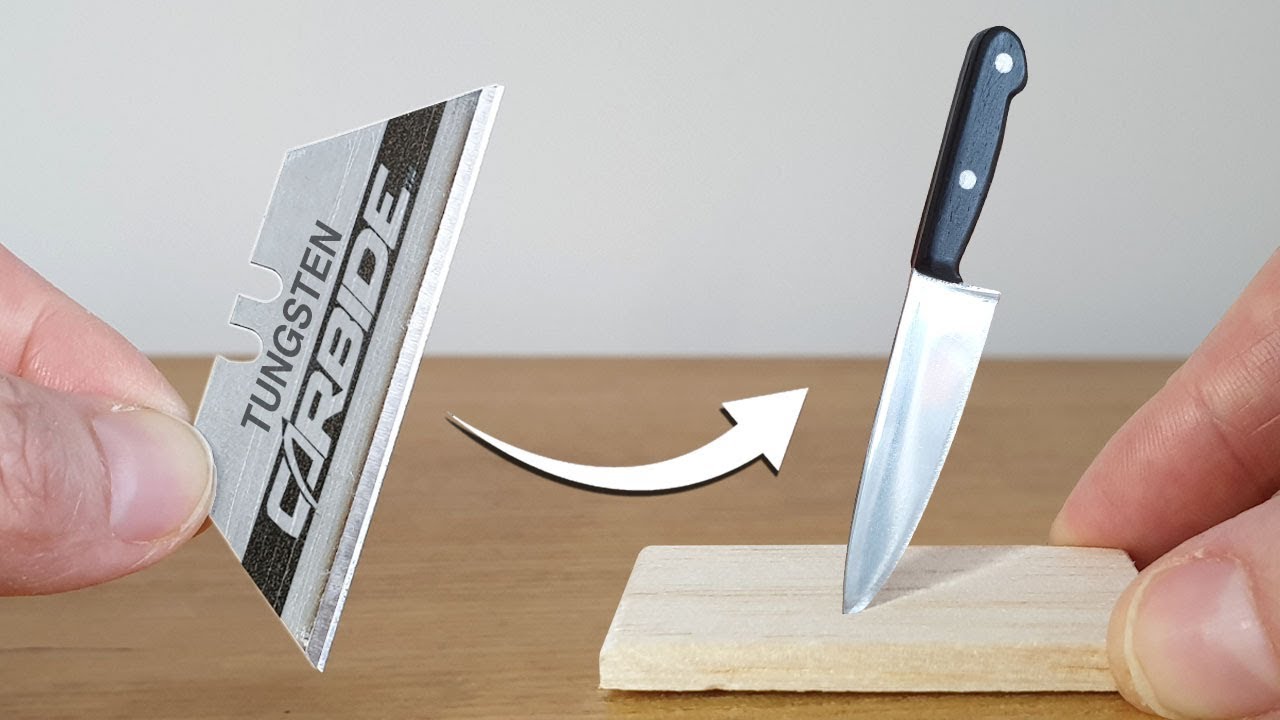
BrainfooTV’s “Made Perfect – with DIAMONDS” runs 8 minutes and 6 seconds, and in that window the channel shapes a fully functional miniature chef’s knife out of a single high-carbon tungsten carbide box cutter blade. There’s no forge, no billet of raw carbide, no dramatic quench — just a hardened strip of scrap steel, a set of diamond abrasives, and a lot of patient grinding down to a blade you could hide behind a coin.
- The knife is shaped entirely from a tungsten carbide box cutter blade, chosen as the template steel for its quality — not because the finished knife is solid tungsten carbide.
- Every cutting, shaping, grinding, and honing step in the build relies on diamond-abrasive tools, which is where the video’s title comes from.
- The end result is a working miniature replica of a standard chef’s kitchen knife, scaled down from stock that started life as a disposable utility blade.
Box Cutter Blades as Stock Material
Box cutter blades aren’t glamorous, but the high-carbon tungsten carbide versions carry a hardness that most scrap steel simply can’t match. That’s the reasoning BrainfooTV lays out at the start of the project: the blade wasn’t picked because it’s exotic, it was picked because it was the best steel on hand for a knife that has to hold an edge at a fraction of normal size. The channel is careful to draw a distinction that’s easy to miss in the title — the knife isn’t carved out of a solid block of tungsten carbide, it’s shaped from a blade that happens to be made with a tungsten carbide edge.
That clarification matters to anyone who’s tried working with true carbide stock, which is notoriously brittle and resistant to conventional filing or sawing. Using the box cutter blade as a donor piece lets the build keep the wear resistance of a premium edge steel while staying within reach of hand tools designed for hardened metal, provided those tools are diamond-based.
Cutting and Shaping with Diamond Abrasives
The title isn’t a marketing flourish — diamond abrasives do the actual work in every stage of the build. Because the source blade is too hard for standard files or grinding wheels to bite into cleanly, the project depends on diamond-coated cutting discs and diamond files to rough out the knife’s profile, taper the spine, and establish the bevel that will eventually become the cutting edge.
It’s the same logic that shows up across precision metalworking and jewelry work more broadly: when a material’s hardness outpaces the tool trying to shape it, diamond is usually what gets called in. Diamond bits handle drilling through material too hard for ordinary bits, diamond wheels grind down metal and glass with control, and diamond-coated discs cut where a standard blade would just skate or dull instantly. BrainfooTV’s build is a small-scale demonstration of that same principle, scaled to a knife you could lose in a toolbox drawer.
The blade isn’t tungsten carbide — it’s shaped from a tungsten carbide blade, and that’s the best steel the build could find.
Sharpening and Finishing the Edge
Getting a miniature knife to actually cut something isn’t just about getting the shape right — it’s about the final edge. That’s where diamond sharpening and polishing abrasives take over from the diamond cutting discs. Fine-grit diamond stones and polishing compounds bring the bevel down to a true edge and clean up the surface finish, the same category of tool serious kitchen-knife sharpeners reach for when they want an edge that holds rather than just looks sharp on camera.
The payoff is a knife that isn’t a display piece — it’s a working replica, meaning the geometry, taper, and edge angle all had to survive the jump from a full-size chef’s knife concept down to a scale where a fraction of a millimeter of error is the difference between a functioning blade and a dull sliver of steel. That’s the tightrope this kind of miniature-tool build always walks, and it’s the same patience-over-power approach that shows up in other hands-on maker projects, whether someone’s building a basket from pine needles or framing out a log cabin workshop by hand.
Salvaged Steel Reveals Fabrication Insights
There’s a broader lesson in BrainfooTV’s choice of material that other DIY metalworkers will recognize: you don’t need a supplier catalog of premium billet steel to get a quality result, you need the right steel for the job and the right tools to work it. A box cutter blade destined for the trash became the donor stock for a knife with real edge retention, purely because the maker matched diamond abrasives to a hardness class that ordinary tools can’t touch.
That’s a mindset that carries over well beyond knife-making — it’s the same resourcefulness you see in builders repurposing scrap and salvage into finished projects, the kind of approach documented in builds like the off-grid woodworking workshop cabin project, where the material on hand dictates the method just as much as the end design does.
BrainfooTV doesn’t waste any of its 8:06 runtime pretending the box cutter blade was anything other than what it is — cheap, hardened scrap steel turned into a knife worth keeping, one diamond pass at a time.








Artist builds his Savannah studio with shipping containers
Robert Wadlow, The Tallest Man in History
The Godmother Of Drumming Plays “Down With The Sickness”
LIFE HACKS for EMBARRASSING MOMENTS that ACTUALLY WORK
Building a Cabin from Pallet Wood: Cheap Off Grid Homestead