

 InfoSearched
Sixty-two feet down, six scientists are living full-time next to a coral reef—for weeks at a stretch.
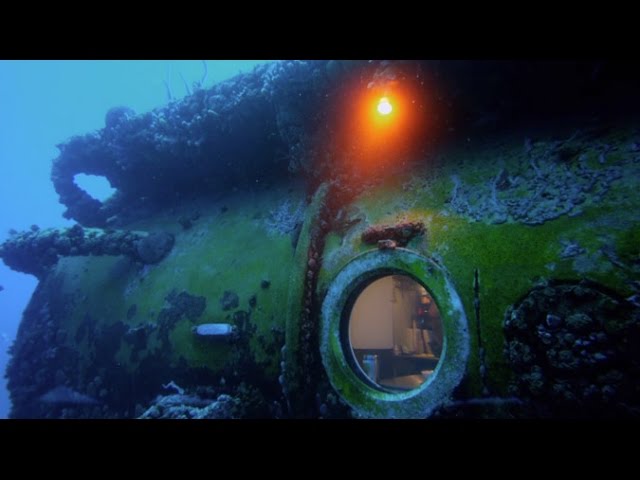
Off the coast of Key Largo, Florida, sits the only undersea research station of its kind on Earth. In June 2014, that station became home to a rotating crew of scientists conducting Mission 31, a monthlong expedition led by Fabien Cousteau to mark 50 years since his grandfather Jacques Cousteau first put researchers inside underwater habitats. NOVA’s Two Weeks Under the Sea follows one of those researchers, aquanaut Liz Bentley Magee of Northeastern University, through her two-week rotation inside the lab.
- Aquarius Reef Base sits 5.4 miles off Key Largo in the Florida Keys National Marine Sanctuary, deployed 62 to 63 feet deep beside Conch Reef and operated by Florida International University.
- Fabien Cousteau lived inside the habitat for the full 31 days of Mission 31, while scientists like Liz Bentley Magee rotated through in two-week shifts to study coral resilience, ocean acidification, zooplankton, and plastic pollution.
- Saturation diving lets aquanauts’ bodies fully absorb ambient gases after 24 hours under pressure, freeing them to work outside the habitat for six to nine hours at a time without stopping for decompression — but it means a mandatory 17-hour decompression inside the chamber before they can finally surface.
A Lab Built to Live On the Seafloor
Aquarius is not a submarine and it doesn’t move. It’s a fixed steel habitat bolted to the ocean floor next to Conch Reef, built to hold a six-person crew along with the computers and lab equipment needed to process samples on-site rather than hauling them to the surface. Because the station stays at a constant 62 to 63 feet, researchers can step outside the hatch and swim directly into the reef they’re studying, day or night, for as long as their air and their bodies allow.
That’s the entire premise behind saturation diving, which Magee walks through in the NOVA segment. After roughly 24 hours living at depth, the tissues in an aquanaut’s body become fully saturated with the ambient gases in the habitat’s air supply. Once that happens, divers stop accumulating additional decompression obligation with each excursion — meaning they can spend six to nine hours on a single dive outside Aquarius instead of the extremely limited window a surface diver gets before needing a slow ascent.
Mission 31’s Anniversary Stakes
Cousteau structured the expedition specifically around a milestone: 50 years since his grandfather’s Conshelf habitats put humans underwater for extended stays in the 1960s. He stayed submerged the entire 31 days to make that connection literal, while teams of visiting researchers, Magee among them, cycled through on shorter two-week stints to keep the science moving without keeping every scientist under pressure for a month straight.
The research agenda covered several fronts at once — checking on the health of marine organisms living around Conch Reef, tracking signs of ocean acidification, monitoring zooplankton populations, and documenting plastic pollution reaching the reef. Magee’s presence inside the habitat let her run tests and log observations in real time rather than waiting for a return trip to a surface vessel.
After about 24 hours at depth, an aquanaut’s body becomes fully saturated — the moment that turns a routine dive limit of minutes into an excursion lasting six to nine hours.
Neighbors to the Reef
Magee describes the arrangement inside Aquarius as functionally becoming a neighbor to the organisms she’s studying. Instead of a single dive window each day, she and the rest of the six-person crew could step outside repeatedly, observe coral and fish behavior at different hours, and return to the habitat’s lab to process what they’d collected before heading back out. That proximity is the entire argument for keeping a fixed lab on the seafloor instead of relying on daily boat trips from the surface.
It’s a different model of ocean fieldwork than the kind covered in Fishpeople | Lives Transformed by the Sea, where the relationship with the water is personal rather than clinical, but both point to the same pull the sea has on the people who choose to spend extended time in it. Divers exploring more accessible underwater terrain, like the ones featured in World-class sinkholes attract divers to South Australian farms, don’t have the luxury of saturation status — every trip down is bound by the standard no-decompression limits that Aquarius was specifically built to get around.
The Cost of Coming Back Up
Saturation status cuts both ways. The same gas loading that frees aquanauts from repetitive decompression stops during their stay also means they can’t simply swim to the surface when the rotation ends. Before Magee or any other crew member could leave Aquarius, they had to sit through 17 hours of controlled decompression inside the chamber itself, slowly reducing pressure until it was safe for their bodies to return to the surface world. Skip that step, and a diver risks decompression sickness serious enough to be life-threatening.
Magee’s two weeks wrapped roughly midway through Cousteau’s 31-day stretch, handing the reef monitoring off to the next incoming crew while Cousteau kept living down there uninterrupted through the end of the mission. For an expedition built to echo his grandfather’s Conshelf work half a century earlier, that 17-hour chamber decompression was the one part of the routine nobody could shortcut, no matter how many days were left on the clock.



Man Who Admits He’s Addicted To Heroin Shows What A Day In His Life Is Like
The Extraordinary Case of Alex Lewis
The Homeless Boy Who Invented Louis Vuitton
DRIVING the Future Mercedes with NO Steering Wheel!!
Stunning Modern, Minimalist Tiny House