

 InfoSearched
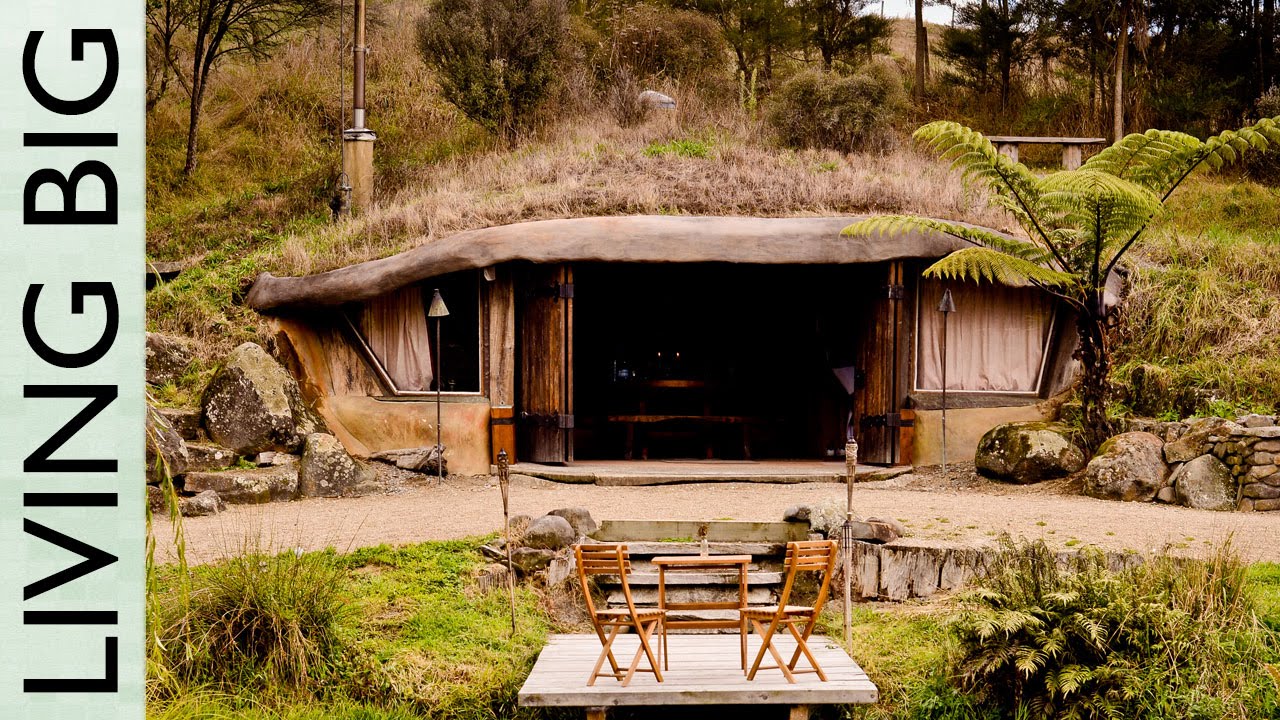
Deep in the Waikato countryside, a door built into a grass-covered hillside leads to a home with no wiring at all.
The retreat is called Underhill, and it’s the subject of an episode of Living Big In A Tiny House, the web series hosted by New Zealand filmmaker Bryce Langston. Built into a farm hillside in Waikato, the earth-covered dwelling was constructed over several years by its creator, Graham Joyce, as a personal passion project rather than a commercial build. The result looks less like a house than something out of the Shire — stone, timber, and turf shaped around a hobbit-hole doorway.
- Underhill was built by hand over several years by Graham Joyce on a farm in Waikato, New Zealand, using stone masonry, structural wood, and earth-covered contours.
- The house was profiled by Bryce Langston on Living Big In A Tiny House, originally released in April 2015.
- The home runs with no electrical wiring: heating and cooking come from a wood-burning stove and hearth, lighting comes from candles and skylights, water is gravity-fed from a natural source, and there’s a hand-crafted outdoor iron bath heated over an open wood fire.
A Hillside Retreat Built by Hand
Joyce didn’t hire a construction crew or draw up architectural blueprints in the conventional sense. Underhill grew out of stone masonry, salvaged and shaped timber, and earth mounded over the roofline until the structure all but disappeared into the hillside it’s carved into. The curved walls avoid straight lines almost entirely, and the ironwork throughout — door latches, fittings, the bath frame — is bespoke, hammered out rather than bought off a shelf.
That handmade quality is the point. Where a typical build gets measured in square footage and turnaround time, Underhill was measured in years of one man’s labor on his own farm. It sits alongside a wave of other unconventional builds that have found audiences online, from the adult-sized hobbit-style tree house that made the rounds in the same eco-building circles, to the subterranean dwellings profiled in Step Inside Australia’s Underground Homes.
Living Without a Grid Connection
Underhill has no power lines running to it and no wiring inside it — a deliberate choice, not a limitation Joyce was working around. Heating and cooking run off a wood-burning stove and open hearth. Light comes from candles at night and from skylights, windows, and doorways left open during the day, letting the interior track the sun rather than a switch on a wall.
Water is gravity-fed from a natural source on the property, piped down to the house without a pump. The signature feature, though, is outside: a hand-crafted iron bath set over an open wood fire, heated the old way, with no boiler or immersion element involved anywhere in the process.
There’s no light switch in Underhill — just candles, skylights, and a wood fire that heats the water for an iron bath standing in the open air.
The Design Philosophy Behind Underhill
Joyce conceived the retreat as an escape from modern distraction and overcomplicated living, favoring hand craftsmanship and raw materials over convenience. That mindset put Underhill in company with the broader off-grid movement that’s built an audience through channels like Living Big In A Tiny House — the same spirit that runs through builds featured in Living a Radically Simple Permaculture Life on 1/4 Acre, where scaling life down is treated as the upgrade, not the sacrifice.
By the time Langston’s episode circulated widely among tiny-house and eco-building audiences, Underhill had already become a reference point for what a genuinely unplugged retreat could look like — not a cabin with solar panels bolted on, but a structure designed from the ground up to need nothing from a grid at all.





Money-Laundering FBI Expert Rates 8 Money-Laundering Scams In Movies and TV | How Real Is It?
The Simplest Way to a Healthy Life | Sadhguru
Buying a $1.6M foreclosure mansion in Henderson, NV.
$13 Million NYC PRIVATE ISLAND Tour!?
He Spent 40 Years Alone in the Woods, and Now Scientists Love Him | Short Film Showcase