


 InfoSearched
Three thousand species, one universal human reaction: nope.
Animalogic’s deep dive into Chilopoda, titled “Centipedes: 3,000 Species of Ultimate Nope,” breaks down exactly why these arthropods trigger such a visceral response — and why the science behind them is far weirder than the average kitchen-floor sighting suggests. Created by Dylan Dubeau and Andrew Strapp, with illustration and hosting from Danielle Dufault, the episode walks through anatomy, venom delivery, and the sheer range of the roughly 3,000 known living species. It’s less a horror reel and more a taxonomy lesson dressed up as one.
- Centipedes always have an odd number of leg-bearing body segments — ranging from 15 pairs to more than 170 pairs — meaning no centipede has exactly 100 legs despite the name.
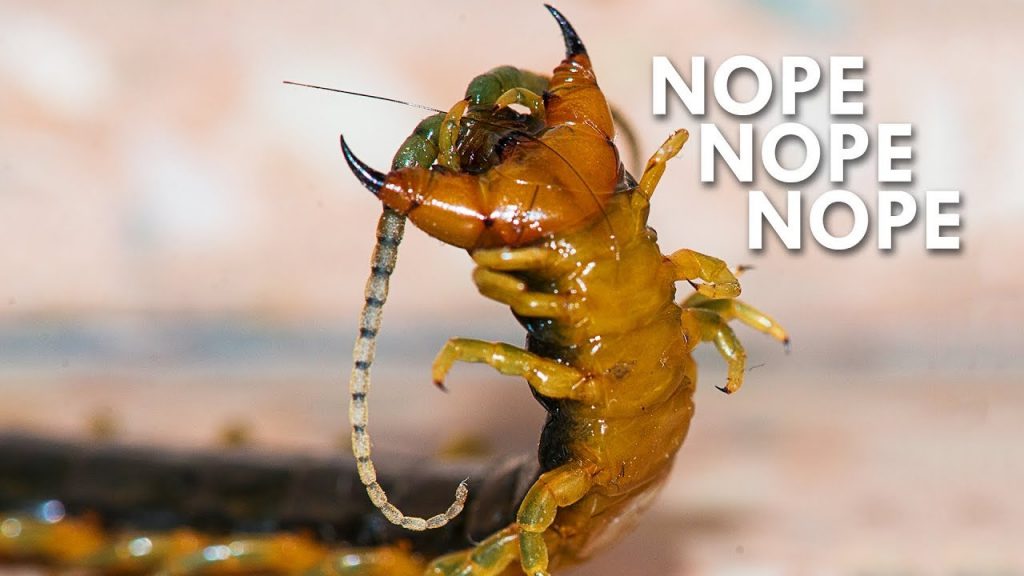
- Their front legs have evolved into forcipules (also called toxicognaths), venomous pincer-like claws used to immobilize prey — they are modified legs, not jaws.
- The common house centipede (Scutigera coleoptrata) hunts roaches, silverfish, and bed bugs, making it a beneficial pest controller despite its unsettling speed.
The Anatomy Behind the Fear
The part of a centipede that actually does the damage isn’t a mouth at all. According to the episode, the first pair of legs behind the head has been reshaped over millions of years into forcipules — hollow, claw-tipped limbs wired to venom glands that inject a cocktail capable of paralyzing prey almost instantly. Because they’re modified legs rather than jaws, they sit in a category of their own among predatory adaptations, and they’re the reason a centipede bite carries a punch disproportionate to the animal’s size.
The rest of the body follows a strict rule that most people get wrong. “Centi-pede” implies a hundred feet, but Animalogic points out that segment counts never land on an even number — species range from 15 pairs of legs up through more than 170 pairs, and every single one of the roughly 3,000 known species falls somewhere on that odd-numbered spectrum. A hundred legs, mathematically, is off the table entirely.
The House Centipede’s Actual Job
For anyone who has flicked on a bathroom light and locked eyes with a fast-moving, long-legged blur, the villain is usually Scutigera coleoptrata — the common house centipede. The episode frames it as a net positive for the household: it feeds on roaches, silverfish, and bed bugs, quietly doing pest-control work that most homeowners never notice or credit. The speed that makes it so alarming to encounter is the same trait that makes it effective at running down other household nuisances before they become an infestation.
That same predatory instinct shows up across the animal kingdom in far bloodier forms, a theme covered in depth in The Most Extreme Wild Animals Battles!, where ambush-and-immobilize strategies play out on a much larger scale than a centipede versus a silverfish.
No centipede on Earth actually has 100 legs — the segment count always lands on an odd number, from 15 pairs to over 170.
Centipedes Hunt Small Vertebrate Prey
At the extreme end of the class, the episode turns to giant scolopendrid centipedes, led by Scolopendra gigantea, the Amazonian giant centipede. These aren’t insect-hunters in the house-centipede mold — they’re large enough and venomous enough to take down lizards, frogs, and even bats, using the same forcipule mechanism scaled up to a much more serious payload. It’s a reminder that “centipede” covers an enormous range of size and lethality across those 3,000 species, from the harmless scurrier under the sink to something capable of snatching a bat out of the air near a cave mouth.
Viewers drawn to that kind of outsized predator behavior might also check out The Blind Assassin of the Desert, which covers a different arthropod built around a similarly specialized strike.
Evolutionary Roots of Human Phobias
None of the biology changes the instinctive recoil most people feel watching a many-legged shape move fast across a floor. Animalogic doesn’t try to argue viewers out of that reaction — it just supplies the facts underneath it: the forcipules, the odd-segment rule, the pest-control upside, and the size range that runs from a few centimeters to the sizable Amazonian giant. Coverage of other small creatures with an outsized reputation, like Top 5 Ferocious Hornet Moments, follows a similar pattern of demystifying the animal without pretending the fear isn’t rational.
The next time a house centipede bolts across the tile at 1 a.m., the math still says it isn’t carrying 100 legs, and the roach it’s chasing was probably the actual problem in the room.








15 RAREST and FREAKY Snakes
The Man Living in Complete Isolation for 40 Years (Part 4/4) | Far Out
Inside Chelsea Handler’s Lively Home With An Outdoor Pizza Oven
This Guy Makes Some Cool Things Out Of Epoxy Resin????????
I spent a week in darkness, here’s what I saw