

 InfoSearched
A cashew never touches a shelf until someone has risked a chemical burn to get it there.
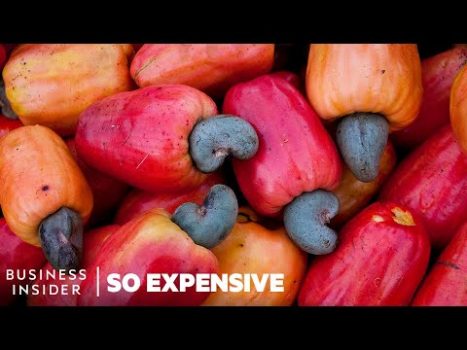
Business Insider’s “So Expensive” series puts the cashew under the microscope, and the numbers explain why a handful of these curved kernels costs more than almost any other nut in the bulk aisle. The global cashew trade is worth more than $6 billion, built on hundreds of thousands of tons of nuts that can’t be cracked by machine without destroying the very thing that makes them valuable — the whole, unbroken kernel.
- Global cashew consumption topped 770,000 metric tons as of 2017, feeding an industry valued at more than $6 billion.
- Wholesale cashews run about $10 per kilogram — over seven times the wholesale price of peanuts — with U.S. retail prices for raw whole cashews reaching $15 per pound.
- Each kernel is sealed inside a double-hulled shell loaded with anacardic acid and urushiol, the same compound that causes poison ivy rashes, making extraction a hazardous, largely manual job.
The Price Gap With Other Nuts
Peanuts are cheap because their shells are inert — crack one open with your thumb and there’s no danger involved. Cashews don’t offer that luxury. According to the report, wholesale cashews sell for roughly $10 per kilogram, more than seven times what peanut buyers pay for the same weight, and that gap holds all the way down the supply chain to the $15-per-pound price tags on raw whole cashews in American grocery stores.
That price isn’t inflated by branding or scarcity of farmland alone. Cashew trees only thrive in a narrow band of tropical climates, and the seed itself grows in one of the strangest configurations in the produce world — dangling from the bottom of an apple-like false fruit rather than sitting inside a protective husk the way a walnut or almond does.
The Shell Acts as Obstacle
Underneath that cashew apple sits a double-hulled shell packed with caustic compounds, chief among them anacardic acid and urushiol — the exact allergen responsible for poison ivy rashes, a hazard covered in detail in how to never have a serious poison ivy rash again. Touch a raw shell without protection and the result is a chemical burn, not just an itch.
One kilogram of raw cashews fetches roughly $10 wholesale — more than seven times what peanut buyers pay for the same weight.
Because that toxic liquid, known as cashew nutshell liquid or CNSL, has to be driven out before the kernel is safe to eat, processors can’t skip straight to shelling. The shells are roasted, steam-cooked, or otherwise heat-treated first, a step that releases fumes hazardous enough that workers routinely coat their hands in protective oils since gloves and other gear degrade quickly under the caustic residue.
Machine Limitations Hinder Performance
Automated shelling exists, but it shatters far too many kernels, and broken pieces sell for a fraction of what whole nuts bring on the market. That economic reality is why cashew processing has stayed stubbornly manual: workers harvest the false fruit, crack the double hull by hand, and pull the kernel out intact whenever possible — the same painstaking extraction detailed in The Crazy Secrets of the Cashew, which explains why raw cashews never reach consumers still in their shells.
Once the kernels are out, the work still isn’t finished. They’re dried, hand-shelled again if needed, and peeled to strip off the papery inner skin called the testa. From there they’re sorted by size and color into grades like whole whites WW240 or WW320 — codes the trade uses to signal exactly how large and uniform a batch of kernels is before it ever reaches a wholesaler’s price sheet.
Every one of those steps — roasting off the CNSL, hand-cracking the hull, peeling the testa, sorting into WW240 or WW320 — is a place where a machine would either ruin the kernel or leave a worker exposed to a chemical that behaves like poison ivy. That’s the actual math behind the $10-per-kilogram wholesale tag, long before a single bag hits a U.S. shelf at $15 a pound.






The Mexican Restaurant Hidden in a Barn on a Rural New York Farm
INSIDE the $40M LARGEST APARTMENT in New York City
Beautiful close encounter with manatees seeking refuge in Florida.
Woodturning – A Coffee Mug
How to Catch a Trout with a Mouse Trap (Ice Fishing)