

 InfoSearched
Turning a key drains a full super of honey without ever cracking the lid.
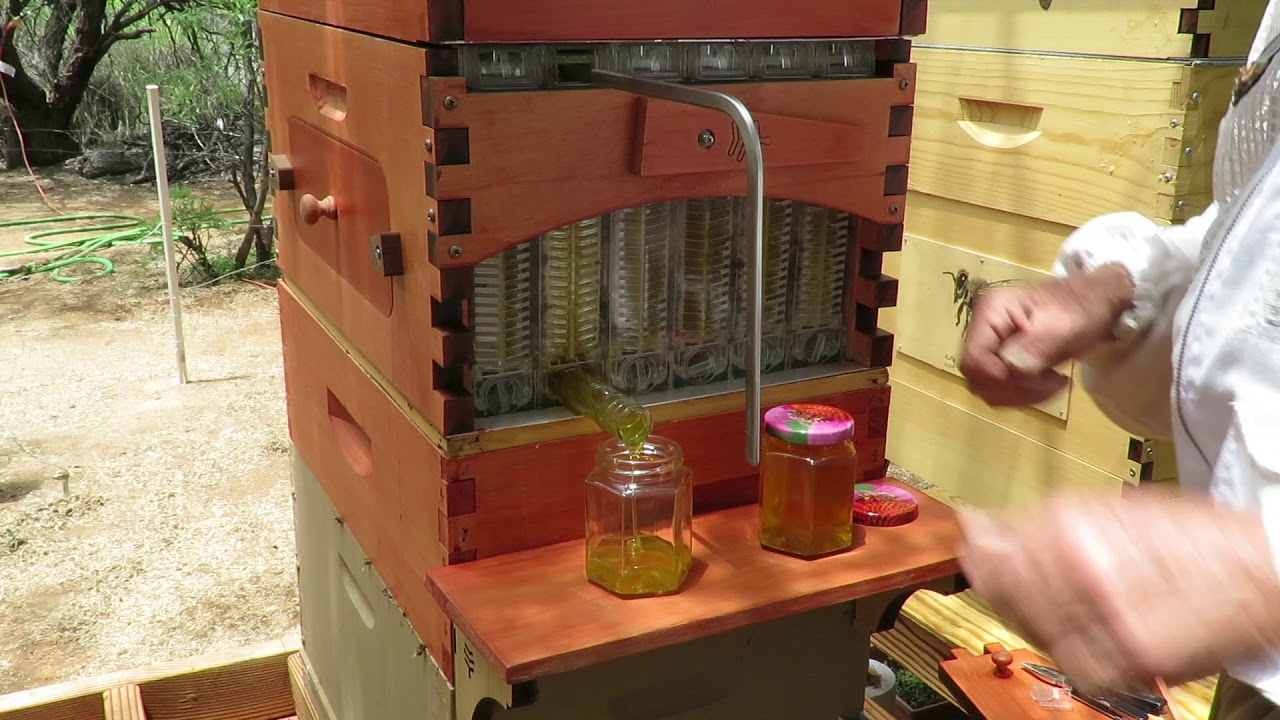
A backyard beekeeper walks up to a hive, checks a small observation window, and decides the frame is ready. No smoker, no pried-open lid, no spinning centrifuge — just a stainless-steel key, a quarter turn, and honey running down a tube into a jar sitting outside the box. That’s the pitch behind the Flow Hive, and this harvest video shows the mechanism working exactly as advertised on a home hive.
- The Flow Hive was created by Australian father-and-son team Stuart and Cedar Anderson and launched via a February 2015 Indiegogo campaign that raised more than $12 million.
- Patented plastic “Flow Frames” slot into the upper honey supers of a standard Langstroth hive; bees finish the partial comb with wax, fill the vertical cells, and cap them before harvest.
- Inserting the Flow Key and turning it 90 degrees splits the comb internally, breaking the wax cappings beneath the surface so honey drains by gravity through a trough and clear tube into a jar outside the hive.
Mechanics of the Flow Frame
The system only functions because the honeycomb itself isn’t real comb built from scratch — it’s a partially formed plastic matrix that the bees complete with their own beeswax. Once the colony draws out the cells, fills them with nectar, cures it into honey, and caps each cell with wax, the frame is ready. Beekeepers confirm this the low-tech way, by looking through the clear end-frame observation windows built into each frame rather than pulling anything out of the box.
From there the harvest is mechanical. The Flow Key goes into the upper slot and gets turned 90 degrees downward, which splits the vertical honeycomb structure internally and breaks the wax cappings from below rather than shaving them off the surface, the way a traditional uncapping knife or fork would. That split forms channels that let raw honey flow straight down by gravity into a trough, out through an inserted clear tube, and into a waiting jar set outside the hive wall.
Minimal Impact on Bee Colonies
The detail that separates this from just “a spigot on a beehive” is what happens to the bees sitting on the comb face when the split occurs. The internal mechanism is engineered to leave small gaps as it shifts, specifically so bees resting on the surface aren’t crushed or injured when the frame’s structure moves beneath them. That’s the whole selling point behind skipping the smoker and the lid — the colony keeps working the rest of the hive undisturbed while honey drains from the frame a few feet away.
Once the jar is full and draining stops, the process reverses just as simply: the key goes into a lower reset slot, returning the internal matrix to its original position. The bees then chew away the broken wax cappings themselves and get to work refilling the comb for the next cycle.
Turn the key, and honey drips straight into the jar — no smoker, no hive box opened, no bee ever touched.
The Pushback From Traditional Beekeepers
The Flow Hive’s ease of use is exactly what drew scrutiny from experienced beekeepers when it launched. Critics inside beekeeping circles have been consistent on one point: the Flow Frame only automates the harvest step. It does nothing to replace the actual colony management that keeps bees alive — regular inspection of the lower brood boxes for disease, mites, and pests still has to happen the old-fashioned way, frame by frame, smoker in hand.
There’s also a practical wrinkle critics flag around the harvest itself. Because honey collects in a jar sitting outside the hive during draining, it can attract robbing bees from other colonies or pests drawn to the exposed sugar source, a risk that doesn’t exist with a sealed extraction indoors. None of that erases what the mechanism does well — it just means the Flow Hive simplifies one job in beekeeping, not the whole craft, the same tension that runs through most backyard permaculture setups where low-maintenance tools still demand real oversight.
Applications for Backyard Beekeeping
For hobbyists who don’t want to run a centrifugal extractor, filter wax debris, or deal with sticky frames on the kitchen table, the appeal is obvious: harvest happens in minutes, mess stays outside, and the colony isn’t cracked open in the process. That’s a meaningful shift for anyone keeping a hive or two alongside a home garden, in the same spirit as growers who’ve dialed in small-scale setups like container berry patches or lawn-to-vegetable conversions, where the goal is maximum yield with minimum disruption to the system already working.
None of that changes the math on cost or scale — a Flow Hive setup runs well above a standard Langstroth box, and it’s built for the two-hive backyard operation shown in this harvest, not a commercial apiary running dozens of colonies. For that audience, though, the trade is straightforward: pay more up front, and skip the extractor, the mess, and the smoker every time a super comes off full.









Herbert Nitsch, The Deepest Man On Earth
NASA’s Plan to Stop an Asteroid Headed for Earth
Top 5 Ferocious Hornet Moments
How To Turn Your Lawn Into A Vegetable Garden
Inside the US-Led Coalition’s Fight Against ISIS