

 InfoSearched
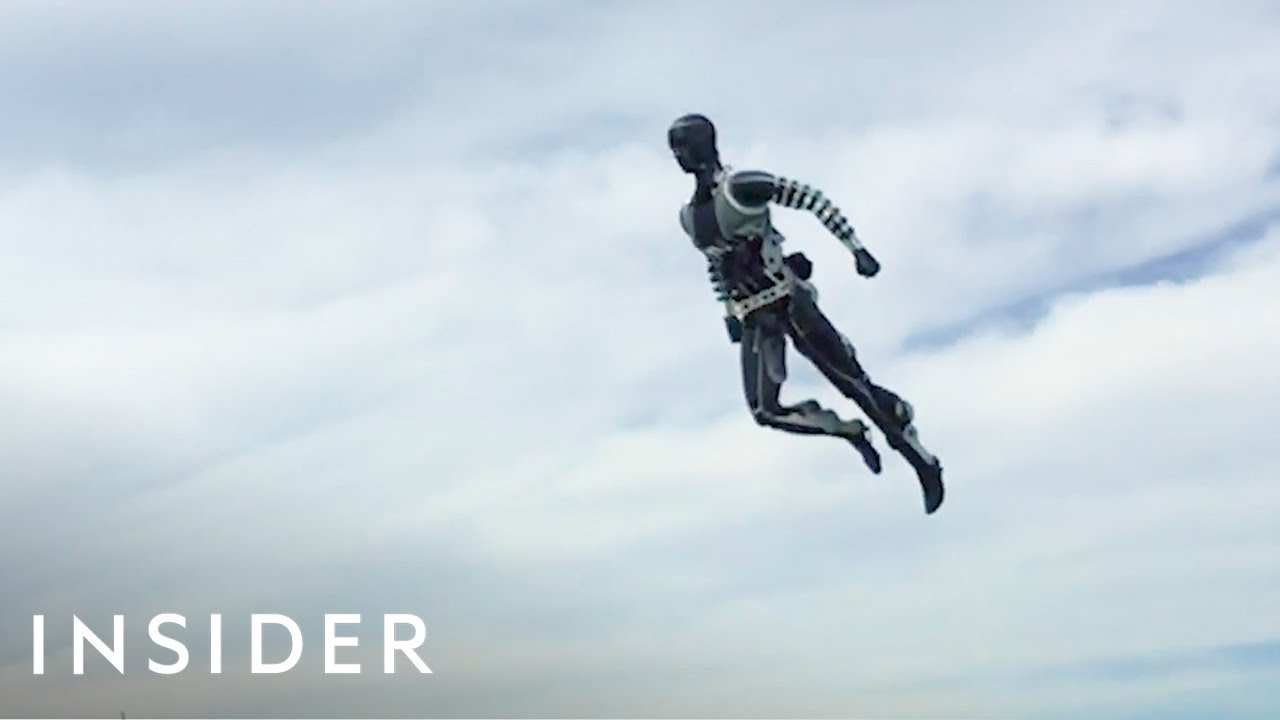
Disney has built a robot that can fly through the air, calculate its own landing, and stick it in a net — over and over again.
Walt Disney Imagineering calls the project Stuntronics, and it’s exactly what it sounds like: an autonomous, acrobatic humanoid built to do things no theme-park performer safely could. Insider’s Movies Insider went inside Disney Research to see how the robot works, and brought in Hollywood stuntman Bobby Holland Hanton — Chris Hemsworth’s regular double in the Marvel Cinematic Universe — to ask the obvious next question: does this thing come for stunt performers’ jobs next?
- Stuntronics evolved through three prototypes — starting with BRICK (Binary Robotic Inertially Controlled bricK), then a Z-shaped tumbling device called Stickman, before landing on a 90-pound, 175-centimeter humanoid with 10 degrees of freedom.
- The robot’s onboard sensor suite — inertial measurement units, gyroscopes, accelerometers, and ground-facing laser rangefinders — lets it calculate its own trajectory and angular momentum in midair, soaring up to 60 feet off a launch wire before deciding when to tuck, twist, strike a pose, or slow its spin to land safely in a net.
- Disney roboticist Morgan Pope and the Imagineering team built it primarily for theme-park stunt sequences, not film sets — but the segment presses stuntman Bobby Holland Hanton on whether the tech could eventually migrate to movie productions.
From BRICK to a Flying Humanoid
Stuntronics didn’t start out looking anything like a stuntman. The earliest version, BRICK, was a bare-bones test rig built to prove Disney’s control software could manage a body’s rotation in freefall. That gave way to Stickman, a Z-shaped robot that tumbled through the air to refine the math before Imagineering ever attached a face or a costume to the thing. Only after those two iterations did the team arrive at the current Stuntronics figure — a 90-pound, 175-centimeter animatronic built with electric DC motors and pneumatic cylinders, wearing whatever superhero suit a park sequence calls for.
That lineage matters because it shows the project was never about building a flashy robot first and figuring out the physics later. Every joint and every sensor exists to solve one problem: how does a body that can’t feel the air around it know when to stop spinning?
Robots Manage Their Own Landings
The answer is onboard computation, done in real time, mid-flight. Stuntronics carries inertial measurement units, gyroscopes, accelerometers, and laser rangefinders aimed at the ground, feeding data into custom control software that tracks the robot’s position and angular momentum the instant it leaves the launch wire. Off a single tether, it can be flung as high as 60 feet — and somewhere in that arc, it has to calculate whether to tuck tighter, open up into a pose, or brake its rotation before it hits the net below.
90 pounds, 60 feet of air, 10 degrees of freedom — and it works out its own landing before it ever touches the net.
That’s the trick that separates Stuntronics from a stunt dummy on a wire: it isn’t following a pre-programmed path so much as reacting to its own flight in the moment, the same way a diver spots the water before tucking out of a somersault. Disney’s roboticists, led by Morgan Pope, built it to repeat that landing reliably, sequence after sequence, without a human absorbing the impact.
Bobby Holland Hanton’s Unique Perspective
Bobby Holland Hanton has spent years doubling Chris Hemsworth’s Thor through some of the MCU’s biggest set pieces, and Movies Insider brought him in specifically to react to the technology. His read cuts against the instinct to declare stunt performers obsolete: a robot can execute a repeatable fall, but it can’t improvise the small physical choices — a flinch, a stumble, a reaction shot — that make a fight scene read as human on camera. Hanton’s argument is less about resisting new tech and more about where the line actually sits between mechanical precision and performance.
That tension between safety-driven automation and the craft stunt performers bring to a film set isn’t unique to this segment — it’s the same debate that surfaces anytime an industry has to weigh how real Hollywood technique actually needs to be against what looks convincing on screen.
Theme Parks First, Film Sets Still Theoretical
For now, Stuntronics is a parks project, not a production tool. Disney Research designed it to pull off superhuman aerial stunts in live shows without putting a performer through repeated hard landings — the same underlying instinct that’s pushed other companies toward autonomous flight hardware, like the personal aircraft behind the Jetson One launch, where removing the human margin for error is the whole point of the engineering.
Whether Stuntronics ever ends up on a movie set instead of a park stage is still an open question the segment doesn’t answer — and neither Disney nor Hanton pretends otherwise. What’s confirmed is a 90-pound robot that can fly 60 feet, read its own trajectory, and stick the same landing on command. Where Hollywood decides to point that is the next story.






12 Most Mysterious Abandoned Places That Hide A Secret
One Homestead Day – Day In The Life On Our Small Farm
3 Years Living In A $1900 Renovated RV – Her DIY Mods & Lessons Learned
How This Woman Makes People Look 2D with Body Paint
The Haunted Island NO ONE Wants to Buy – 15 Islands you can buy