

 InfoSearched
A YouTube maker spent three builds chasing a pen that turns into a sword.
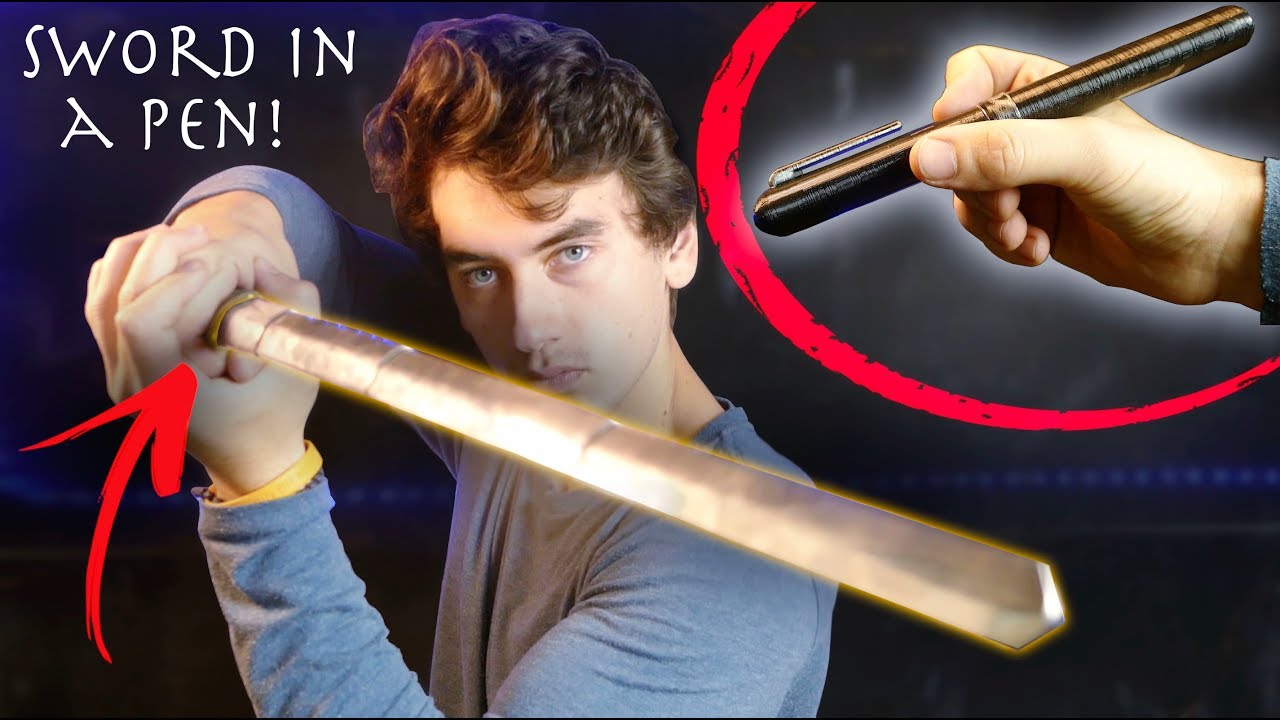
Jake Laser, who posts DIY and prop-building projects under the channel JLaservideo, set out to build a working version of Riptide — the celestial bronze sword that Percy Jackson carries disguised as a ballpoint pen in Rick Riordan’s book series. His video, “Make Riptide (Expandable Pen Sword) From Percy Jackson! – Full Metal, Low Cost Build,” walks through three separate prototypes before landing on a design that actually deploys like a blade instead of a novelty gadget.
- The first prototype relied on a CO2-powered telescoping rod that deployed fast but looked like a radio antenna, not a sword.
- The second version hid a magician’s expandable steel pocket staff inside a custom 3D-printed pen shell, deploying with a twist of the casing — but the rolled spring steel had no rigidity or edge.
- The third and final build used a low-cost, full-metal expandable sword mechanism modified to compact into a pen case, and it held up to impact and cutting tests while still passing as an everyday pen when closed.
Chasing the Right Form Factor
Laser’s challenge wasn’t just making something spring open fast — it was making it look and behave like an actual blade once it did. That’s the gap between a party trick and a convincing prop, and it’s why he scrapped his first two attempts rather than settling for “close enough.”
His first prototype leaned on a CO2-powered telescoping rod mechanism, the kind of rapid-deployment system you’d find in a pneumatic antenna. It worked exactly as intended in terms of speed, snapping open on command. The problem was cosmetic: once extended, the thin segmented rod read as exactly what it was — an antenna — rather than anything resembling Anaklusmos, the “riptide” blade from Riordan’s mythology.
The Magician’s Staff Attempt
For his second pass, Laser switched components entirely, sourcing a magician’s expandable steel pocket staff — the kind used in stage performances for quick-draw illusions — and housing it inside a pen shell he designed and 3D-printed himself. Twisting the casing triggered the deployment, which finally gave the build a proper “pen becomes weapon” motion.
But the core material undid the effect. Rolled spring steel, built for a magician’s staff rather than a blade, had no structural rigidity and no real edge geometry. It could extend and look sword-shaped from a distance, but it wouldn’t hold up to any actual contact.
The Full-Metal Build That Finally Worked
The third version is where the project turns from prop-making into legitimate engineering. Laser built a low-cost, full-metal expandable sword mechanism and modified it to compress down into a functioning pen case — solving the rigidity problem the second prototype couldn’t crack.
The third build produced a much more rigid, robust blade that successfully withstood impact and cutting demonstrations while remaining compact enough to resemble an everyday writing instrument when retracted.
That combination — real structural strength plus a low parts cost — is the throughline of the whole video. Laser isn’t chasing screen-accurate cosmetics for their own sake; he’s iterating toward a mechanism that a hobbyist could realistically replicate on a budget, the same instinct that drives a lot of the scrappier builder content in the DIY and projects space, including solo overnight builds in the woods where cost and material limitations force the same kind of creative problem-solving.
The Importance of Iteration
Each failed version wasn’t wasted — it isolated a specific flaw. The CO2 rod proved speed was solvable but form factor wasn’t. The magician’s staff proved form factor was solvable but rigidity wasn’t. Only the full-metal expandable mechanism solved both at once, which is why Laser presents it as the finished build rather than another checkpoint.
That kind of build-fail-rebuild documentation is common across the maker-project corner of YouTube, the same audience that follows low-cost, materials-first builds where the appeal is seeing someone solve a design problem with what’s actually available rather than an ideal parts list.
By the third prototype, Laser had a pen that opens into a blade sturdy enough to cut and take impact, and closes back down small enough to sit in a shirt pocket without a second look — which, for a weapon that’s supposed to pass as an ordinary pen until Percy Jackson needs it, is the whole point of the design.







HOW MUCH $$$ DOES WRAP COST? | The REAL STORY Shops Might Not Tell You!
RJ Mitte of ‘Breaking Bad’ on Living with Cerebral Palsy
Stealth Camping In Airport Parking Lot With SUV (Highly Patrolled)
How a Tranquilizer Dart Works in Slow Motion
Inside Liv Tyler’s Gut-Renovated NYC Brownstone