

 InfoSearched
One YouTuber walked in cold to try the test that decides who gets a shot at Air Force Pararescue — and found out fast why most people don’t survive it.
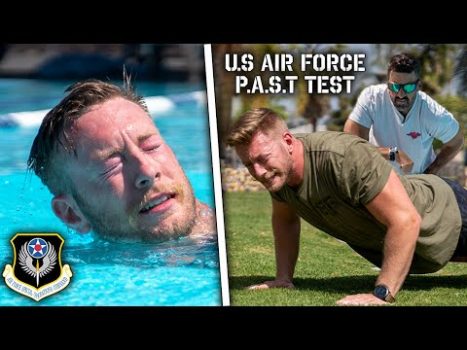
Austen Alexander, a fitness YouTuber and former active-duty Navy sailor, set out to take the Air Force Special Warfare Physical Ability and Stamina Test — the PAST — with zero targeted prep. The PAST is the screening gate for candidates chasing Pararescue (PJ), Combat Control (CCT), and Special Reconnaissance slots, and it doesn’t hand out partial credit. Running the evaluation was Brian Kimber, a former Air Force Pararescueman, grading every rep and every stroke the way an actual accessions cadre would.
- The dry-land portion demands strict-cadence pull-ups (minimum 8), a two-minute sit-up test (minimum 50), a two-minute push-up test (minimum 40), and a 1.5-mile run that must come in under 10 minutes, 20 seconds for standard Special Warfare Open Enlistment.
- The pool portion follows immediately: two consecutive 25-meter underwater swims, pass/fail with rest between them, then a continuous 500-meter swim with a 15:00 cutoff for new enlistees (12:30 for retrainees or prior-service candidates).
- Brian Kimber, a former Pararescueman, proctored the entire test, judging rep lockouts, underwater composure, and pacing against real Air Force grading standards.
The Gatekeeper for Pararescue, CCT and Special Reconnaissance
The PAST isn’t a general fitness quiz — it’s the first real filter the Air Force uses before it invests a dime in training someone for the Special Warfare pipeline. Fail one event, and the whole test is scored a failure, regardless of how well the rest went. That single rule is what makes the format brutal: a candidate can crush the run and the push-ups and still walk away with nothing if the pull-up bar or the pool gets him first.
Alexander went in without rehearsing any of it specifically, treating the attempt as a real-world gut check rather than a training-camp simulation. That’s consistent with how a lot of creators in the tactical-fitness space frame these challenges — for context, readers who found this compelling might also check out Why You Never Mess With Elite Special Forces, which digs into what separates these units from conventional infantry.
Dry Land First: Pull-Ups, Sit-Ups, Push-Ups and the Run
The revised PAST format starts on land before it ever gets near water. Strict-cadence pull-ups come first, with a floor of eight reps and no swinging or kipping tolerated — Kimber’s job was to enforce full-lockout form the way an actual evaluator would, not let borderline reps slide. From there it’s a two-minute sit-up test with a 50-rep minimum, followed immediately by a two-minute push-up test requiring at least 40.
The run closes out the land events: 1.5 miles that has to be covered in under 10 minutes and 20 seconds under the standard Open Enlistment standard. That number sounds survivable on paper for anyone with decent cardio, but it’s designed to be the last land-based gut check before fatigue carries straight into the pool — which is exactly where the test starts separating people.
The Pool Doesn’t Care About Gym Numbers
Once the calisthenics and run are done, the PAST moves to the water for its two final, and arguably hardest, events. First up are two consecutive 25-meter underwater swims, scored strictly pass/fail, with a rest period between them — a test of breath control and calm as much as raw swimming ability. Then comes the continuous 500-meter swim, which has to be finished in under 15:00 for new enlistees, or 12:30 for retrainees and prior-service candidates.
Fail any single event, and the entire PAST is scored a failure — there’s no partial credit for a strong run if the pool gets you.
That’s the trap Alexander was up against without dedicated swim training. Gym strength and land conditioning don’t automatically translate to underwater composure or 500-meter pacing, and the Air Force built the test that way on purpose — the pipeline is full of candidates who look fit on paper and still wash out in the water.
Kimber’s Standard: No Practice, No Mercy
Throughout the attempt, Kimber’s role wasn’t just timekeeping — he graded lockouts on the pull-up bar, watched form deteriorate under fatigue on the push-up and sit-up counts, and evaluated how composed Alexander stayed on the underwater swims. That’s the same scrutiny real PJ, CCT, and Special Reconnaissance hopefuls face before they’re ever cleared to start the actual pipeline. Viewers interested in how that pipeline’s culture compares to other elite units can find more in The Most Secretive Unit in United States.
The 500-meter swim is where the PAST really shows its teeth — it comes last, after every other event has already drained the tank, and the clock doesn’t care how good the pull-up numbers looked twenty minutes earlier. That’s the event that turns a solid overall showing into a fail line on the scoresheet, and it’s the one Kimber was watching closest the whole way through.





Everything is BIGGER in Texas!
Cash Slaves: Inside the Dystopian Fetish of Financial Domination
How To: Removing a Load Bearing Wall! (EASY STEP-BY-STEP)
Why Escobar’s Hippo Legacy Still Haunts Colombia
Living a Radically Simple Permaculture Life on 1/4 Acre