

 InfoSearched
An East Sacramento backyard goes from dead turf to a working farm stand in one build.
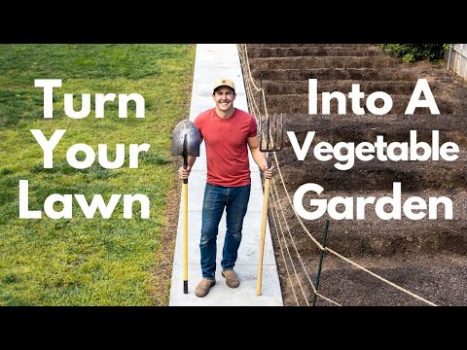
Kyle Hagerty didn’t inherit a homestead — he inherited a weed-choked, largely abandoned lawn on a standard 2,500-square-foot residential lot in East Sacramento, California. In his video “How To Turn Your Lawn Into A Vegetable Garden,” the urban farmer and content creator behind Urban Farmstead walks through exactly how he stripped that turf down to bare dirt and rebuilt it into a producing vegetable operation. It’s less inspiration reel than field manual, with every step — demolition, soil amendment, bed layout, irrigation, planting — shown in sequence.
- Hagerty converts a 2,500-square-foot turfgrass lawn in East Sacramento into a full vegetable garden, starting by excavating and stripping out sod, weeds, and turf roots.
- He aggressively amends the exposed native soil with compost and organic matter before shaping in-ground planting beds and defined walking paths.
- The build adds drip irrigation lines and vertical trellises to maximize yield on the tight urban footprint, then seeds it with vegetables, greens, and fruit trees.
Tearing Out the Turf
The first phase is the least glamorous and the most labor-intensive: getting rid of the grass entirely. Hagerty doesn’t just mow down or smother the existing lawn — he excavates it, pulling up sod, weeds, and turf roots so nothing regenerates underneath the new beds. That root-and-all removal matters because leftover turf rhizomes are one of the most common reasons backyard conversions fail within a season, with grass creeping back through loosely amended soil.
Once the lawn is stripped, what’s left is the compacted, nutrient-thin subsoil typical of residential turf — soil that’s been mowed and walked on for years but never fed. That’s the blank canvas Hagerty works with for the rest of the build, and it’s why the next step gets so much attention in the video.
Rebuilding the Soil From Scratch
With the sod gone, Hagerty turns to amending the native yard soil directly rather than trucking in raised-bed frames full of bagged mix. He works compost and rich organic matter into the exposed ground, aiming to convert dead lawn dirt into something that can actually feed a vegetable crop. It’s a deliberate choice: in-ground beds built on properly amended native soil hold moisture and nutrients differently than boxed raised beds, and on a 2,500-square-foot lot, every inch of usable growing space counts.
An abandoned, weed-filled lawn becomes a fully organic backyard farm — same footprint, same soil, completely different function.
Laying Out Beds, Paths, and Irrigation
From there, Hagerty shapes the amended soil into defined in-ground planting beds separated by clear walking paths — a layout choice that keeps foot traffic off growing soil and makes harvesting manageable in a small space. He then installs a drip irrigation system across the beds, the standard efficiency upgrade for anyone trying to keep a dense vegetable garden watered without wasting water or flooding root zones.
To stretch the footprint further, he adds vertical trellises for climbing crops, a technique any grower working a compact urban lot leans on to get more production out of less square footage. Readers looking at similar space constraints might find useful parallels in approaches like growing raspberries, blueberries, and blackberries in containers, another method built around maximizing yield when ground space is limited.
Planting the Homestead
The final phase is where the transformation actually pays off: Hagerty seeds the new beds with a diverse mix of seasonal vegetables, greens, and fruit trees, turning the reworked lawn into a genuine food-producing system rather than a decorative garden. The result is a self-sustaining backyard setup that functions less like a hobby plot and more like a scaled-down homestead — the kind of project that echoes the broader push toward small-footprint food independence seen in builds like a radically simple permaculture life on a quarter acre.
Hagerty’s build lands on a simple point: a dead 2,500-square-foot lawn doesn’t need to become a bigger lawn. Strip it, feed the soil, run drip lines and trellises, and put seeds in the ground — that’s the whole conversion, and it’s the same sequence he shows start to finish in the video.







Man captures all walks of life crossing log bridge
PLEASE HELP: What Should I Do With All These FIRE ANTS?
Simple Tricks to Keep Your Garden PEST FREE!
Exploring The Most Beautiful Place on Earth
Why You Never Mess With Elite Special Forces