

 InfoSearched
A single mating flight decides which queen lives — and which ones get torn apart by their own daughters.
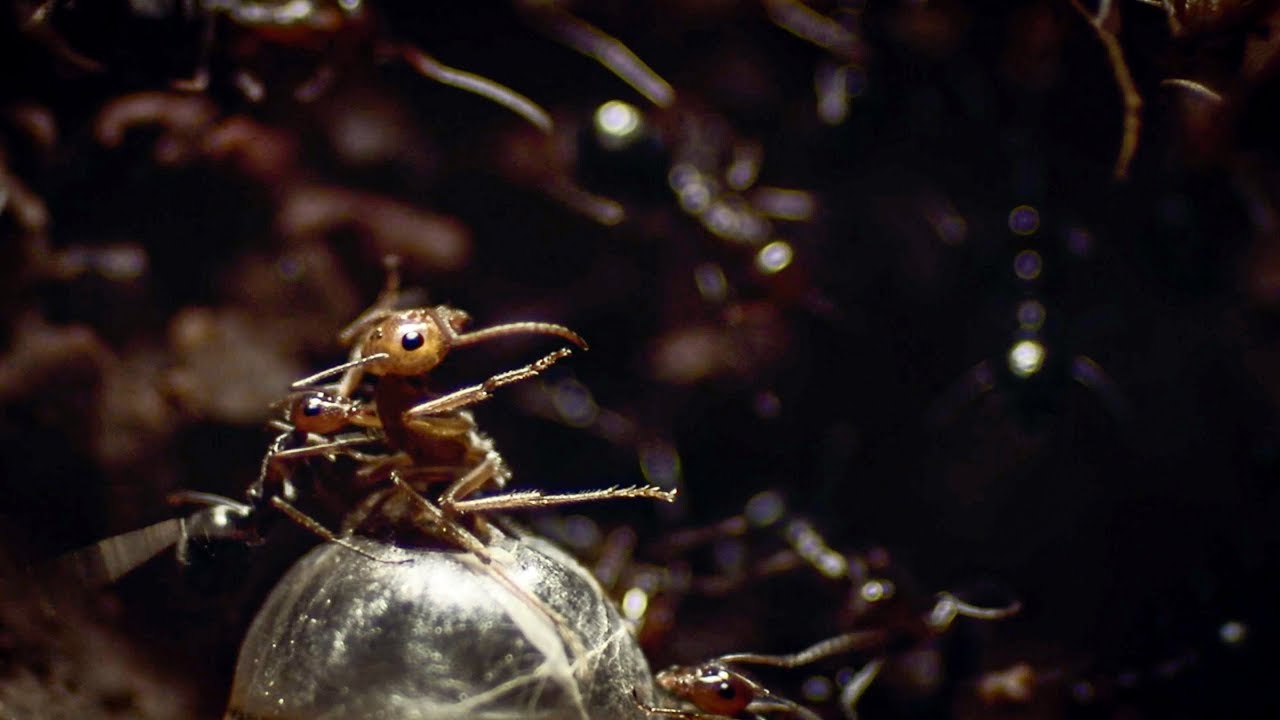
The BBC’s Empire of the Desert Ants, part of the Natural World strand, spent roughly 150 days filming in the Chiricahua Mountains of southern Arizona to document one of the more brutal succession stories in the insect kingdom. At the center of this clip is the honeypot ant, Myrmecocystus mimicus, and a founding strategy that starts as cooperation and ends in execution.
- Multiple unrelated honeypot ant queens team up after a single annual mating flight to dig a shared founding burrow and build up brood faster than a lone queen could manage.
- Once the first generation of worker ants matures, the colony’s strict monogyny takes over — only one queen is allowed to survive as egg-layer.
- Workers turn on the extra queens, pinning them down and tearing off their legs and antennae before killing or driving them out.
Filming a Hidden War Underground
Capturing this kind of behavior on camera is not a matter of pointing a lens at a hole in the sand. The production relied on specialized macro-photography inside interconnected artificial nest systems engineered by entomological designer Ray Mendez, allowing filmmakers to follow individual ants through tunnels and chambers that would otherwise be invisible. Combined with the months spent on location in Arizona’s arid country, that setup is what makes it possible to watch a queen lose a leg in real time rather than infer it from a fossil record of carnage after the fact.
Reasons for Rival Queen Alliances
According to Bert Hölldobler, the Arizona State University ant biologist who served as the documentary’s scientific advisor, unrelated queens tolerate each other in the earliest stage of colony founding because bigger, faster-growing colonies have a much better shot at surviving — and at raiding the brood of weaker neighboring nests. Pleometrosis, the technical term for this multi-queen founding strategy, is a numbers game: more queens laying eggs simultaneously means more workers, faster, in a landscape where slower colonies simply get plundered.
Larger, faster-growing colonies are far better equipped to survive and raid neighboring nests for brood.
The Purge That Follows
The alliance has an expiration date built into it. The moment that first cohort of workers emerges and starts working for the colony, the arrangement that got everyone this far becomes a liability. Honeypot ant society runs on monogyny — one queen, one ruler, no exceptions — and the workers enforce that rule themselves. Redundant co-founding queens get pinned, their legs and antennae systematically torn off, and they’re either killed outright or expelled from the nest their own effort helped build.
It’s the same violent efficiency that shows up across the desert food chain in Arizona’s Sonoran and Chihuahuan reaches, where creatures ranging from ambush predators built for scarcity to social insects like these honeypot ants have all evolved brutal shortcuts to outlast a landscape that punishes hesitation. Colony-level violence isn’t unique to this species either — anyone who’s watched footage of a hornet raid knows insect societies settle disputes with force rather than diplomacy, a theme that runs through clips like other ferocious hornet encounters caught on camera.
One Queen, One Colony
What’s left after the purge is a single matriarch sitting on top of a colony that, by the time the fighting is over, may already number in the thousands. Every worker in that nest, and every queen that didn’t survive the transition, came from the same founding burrow — proof that in honeypot ant society, the cooperation that builds an empire and the violence that decides who rules it are two phases of the exact same plan.









A Japanese Master Craftsman Taught Me To Make Senko Hanabi Fireworks
Why Rolls-Royce Cars Are So Expensive
Billionaire in ‘World’s Toughest’ Prison Accused of Cop’s Death
New Earthships capture more energy, water & food at lower cost
Occupy Tower: Living in the world’s tallest slum – the “Tower of David”