

 InfoSearched
Four everyday objects go into a vat of water and come out looking like nothing else you own.
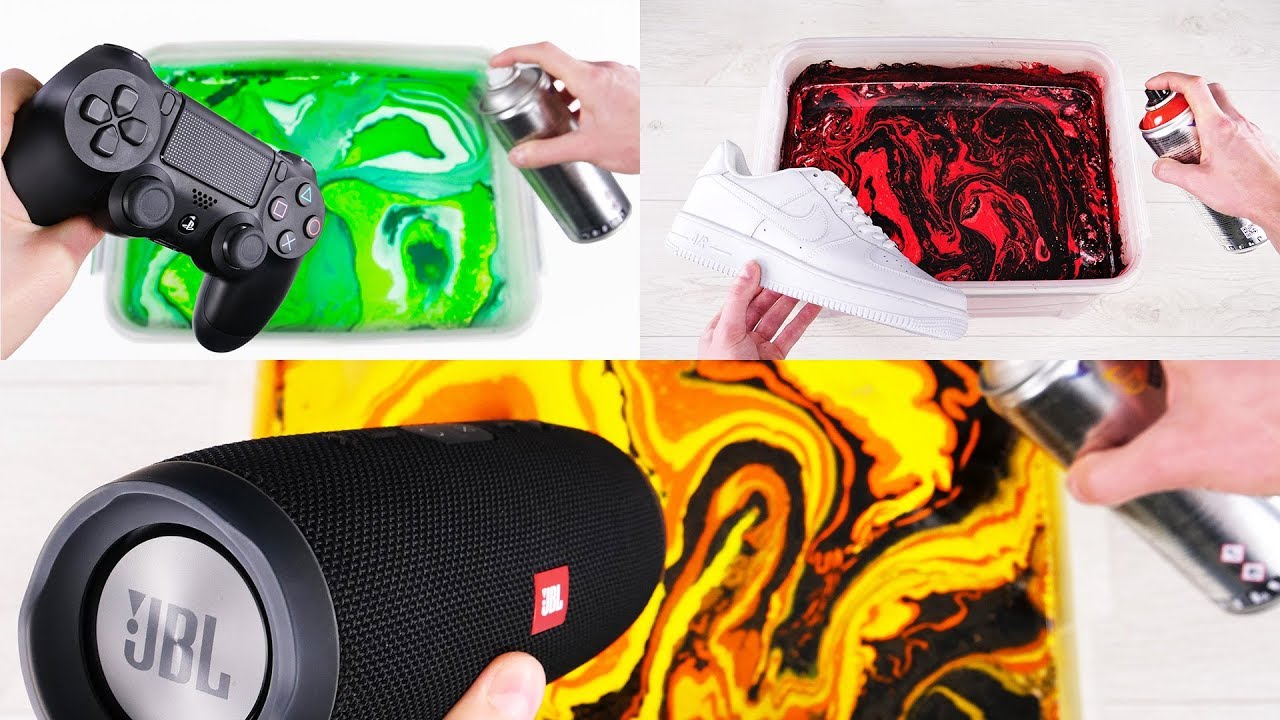
The Q, the DIY and engineering channel known for stripping down machines and rebuilding them with a twist, put together a compilation showing hydro dipping at its most versatile. Instead of one long tutorial on a single object, the video strings together four separate transformations — a pair of Nike Air Force sneakers, a Sony PlayStation 4 Pro shell paired with its DualShock controller, a JBL Charge Bluetooth speaker, and a Fender Stratocaster-style guitar body — each run through the same water-transfer printing process from prep to clear coat.
- The compilation covers four distinct hydro dipping projects: Nike Air Force sneakers, a PS4 Pro console shell with matching DualShock controller, a JBL Charge speaker, and a Stratocaster-style guitar body.
- Every segment follows the same core workflow — masking and base-coating the object, floating hydrographic film on a water vat, activating it into liquid ink, then dipping the piece at a controlled angle so the pattern wraps around its curves.
- Hydro dipping itself is an industrial method borrowed from automotive trim, firearm camo, and consumer plastics work, repurposed here for gaming gear, footwear, audio tech, and instruments.
The Prep Work Nobody Skips
Before anything touches water, each object gets taken apart. The sneakers are masked around the soles and eyelets so no adhesive or paint bleeds where it shouldn’t; the PS4 Pro shell and controller are separated from their internal boards entirely, since electronics and a water vat don’t mix. The JBL Charge gets its speaker grille and rubber seals protected, and the guitar body is pulled off its neck and hardware so the water transfer film has a clean, uninterrupted surface to grab.
Base coat matters just as much as the film pattern. A light color underneath changes how the transferred graphic reads once it’s dry — the video treats this step as non-negotiable, since a rushed base coat is the most common reason a hydro dip job looks patchy instead of seamless.
Film Transfer Process Overview
The hydrographic film — a thin, printed sheet — gets laid flat across the surface of the water vat. Once it’s positioned, an activator spray chemically breaks down the film’s carrier layer, turning it into a liquid ink suspended right at the water’s surface. That’s the moment that makes or breaks the whole project: the object has to go in at a steady, controlled angle so the pattern wraps around every curve of the sneaker, the console shell, the speaker body, or the guitar’s contours without stretching, tearing, or trapping air bubbles underneath.
The angle of entry decides whether the design wraps clean around a curve or bunches up and tears — there’s no fixing it once it’s in the water.
After the dip, each piece gets rinsed to remove leftover film residue, dried fully, and finished with a clear coat to seal the pattern and protect it from scuffing, moisture, and UV fading. Only after that cure does reassembly happen — soles back on the sneakers, boards back in the PS4 shell, grille back on the JBL Charge, hardware back on the guitar.
Reasons for Widespread Maker Adoption
Hydro dipping isn’t new — it’s been used for decades on automotive trim pieces, firearm camo patterns, and molded consumer plastics. What changed in the late 2010s was accessibility: film and activator kits became cheap enough, and tutorial videos detailed enough, that hobbyists could run the same industrial process on gear they already owned. That shift turned hydro dipping into a maker-culture staple, showing up across the same DIY spaces that cover other hands-on customization projects, from console shells to skateboard decks.
Sneakers in particular became a natural fit. Customizing a pair of Air Forces with a hydro-dipped pattern taps into the same sneaker-culture instinct that drives limited colorways and resale hype — the appeal of owning something nobody else’s pair looks like, a theme that runs through plenty of footwear and style customization content built around personalizing off-the-shelf gear.
Of the four builds in the compilation, the guitar body is the one that demands the most patience — a Stratocaster’s contoured curves and horn cutaways give the film far more surface to wrap around than a flat speaker face, which is exactly why The Q saved it for last.







Why I dress as a Regency gentleman… everyday of my life
One of the Oldest Ever People with Progeria (The Disorder That Makes You Age Rapidly)
5 Fruit Trees that are too EASY to GROW in the Home Garden
Eating Giant Rat with Miss Nigeria!!
This Is Why the Childhood of Rabbits Is so Terrible