

 InfoSearched
A sea cave on Scotland’s Moray Firth is forcing archaeologists to rethink what Bronze Age Britain did with its dead.
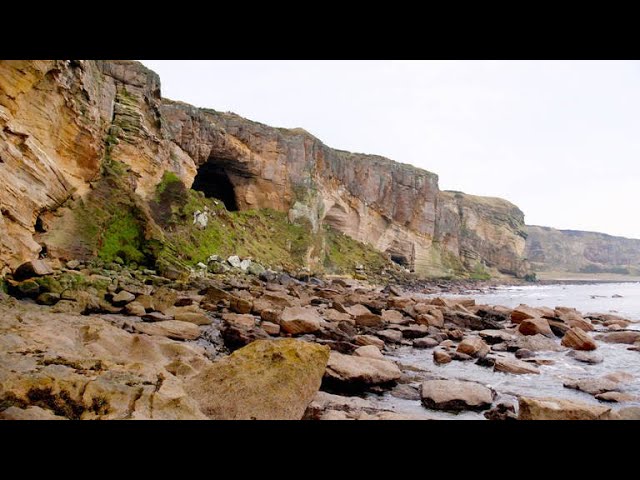
Smithsonian Channel’s Was This Cave an Ancient Lab for Preserving Human Bodies? takes viewers into Covesea Cave, better known to archaeologists as the Sculptor’s Cave, tucked into the coastline of northeast Scotland. Inside, researchers have pulled an unusually large cache of human bone dating to the Late Bronze Age and Early Iron Age — bone that survived far better than it should have, given thousands of years underground.
The condition of those remains, combined with the cave’s odd internal environment, has investigators asking whether this wasn’t just a burial spot but something closer to a processing site — a place where bodies were deliberately dried, smoked, or otherwise treated before people took them elsewhere for their final rest.
- Covesea Cave on the Moray Firth has produced well-preserved human skeletal remains dated mainly to the Late Bronze Age and Early Iron Age.
- The cave’s dry, sheltered interior, high salinity from coastal sea spray, and physical evidence of fires point to conditions that could have supported intentional preservation rather than simple deposition of the dead.
- The Covesea findings connect to the Cladh Hallan discovery on South Uist, where archaeologist Mike Parker Pearson found Bronze Age bodies deliberately preserved through short-term immersion in acidic peat bogs before being reassembled into composite “Frankenstein” skeletons.
Inside the Sculptor’s Cave
Covesea Cave sits on the southern shore of the Moray Firth, a stretch of coastline that has drawn archaeologists back for decades because of what keeps turning up in its sediment. The bone assemblage recovered there is large enough, and preserved well enough, that researchers can’t easily explain it away as an ordinary burial ground. Most of it dates to the transition between the Late Bronze Age and Early Iron Age, a period when cremation and simple inhumation were the norm across much of prehistoric Britain — making this collection of intact skeletal material stand out.
What makes the cave itself unusual is its microclimate. Sea spray off the Moray Firth loads the air inside with salt, the cave stays dry and sheltered from the elements, and archaeologists have found clear evidence of fires burning within the chamber. Salt, dryness, and smoke are exactly the ingredients you’d use if you were trying to cure a body rather than simply leave it to decompose — which is the working theory researchers are testing against the bone record.
Testing the Mortuary Lab Theory
The question driving the investigation is straightforward: did prehistoric communities on this coast use Covesea Cave as a working mortuary lab, drying or smoke-curing bodies before moving the remains elsewhere for secondary burial? That would represent a level of deliberate, technical engagement with the dead that most textbooks on ancient Northwestern Europe simply don’t describe.
The bone survived because the cave was drying it out on purpose — not because the ground happened to be kind to it.
Skeletal analysis at the site has focused on signs of excarnation — the deliberate removal of flesh from bone — and on whether bodies were curated and revisited by the living rather than buried once and left alone. That pattern of returning to and handling ancestral remains shows up elsewhere in Bronze Age Britain, which is what makes Covesea part of a bigger story rather than an isolated oddity. Readers who want more on how forensic teams read a body for hidden history will find plenty of overlap with 5 Craziest Things I’ve Found In Dead Bodies, where the same kind of bone-level detective work plays out in a modern setting.
The Cladh Hallan Connection
None of this reads in isolation from Cladh Hallan, the South Uist site where Mike Parker Pearson’s excavations uncovered Bronze Age bodies buried beneath the floors of domestic roundhouses. Parker Pearson’s team determined those bodies had been artificially preserved, most likely through brief immersion in acidic peat bogs, then retrieved later and assembled into composite skeletons built from more than one individual — bones from different people combined into a single burial, a practice that earned the Cladh Hallan remains their “Frankenstein” nickname.
Cladh Hallan broke the long-standing assumption that mummification simply wasn’t part of the ancient European toolkit — that it was something Egypt and the Andes did, not Iron Age Scotland. Covesea Cave gives that argument a second data point on a different coast, with a different preservation method: fire and salt air instead of peat acid, but the same underlying instinct to keep the dead intact and available to the living for longer than a single burial would allow.
Unresolved Mysteries of Ancient Remains
The honest caveat researchers keep circling back to is that preservation and intent are two different things to prove. A cave can dry out bone by accident just as easily as by design, and separating a genuine mortuary lab from a naturally favorable hiding spot requires more than one striking skeleton — it requires a pattern across dozens of individuals, consistent handling marks, and fire evidence that lines up chronologically with the burials rather than predating or postdating them. That’s the case Covesea’s excavators are still building, bone by bone, against a coastline that has already given up more than anyone expected from a cave this size.






Inside The Rock’s $100 Million Dollar Mansions
Dubai Luxury Villa
Making a TITANIUM Axe
Turning Smashed TVs into Realistic Artificial Daylight
Can Israelis and Palestinians See Eye to Eye? || Creators for Change