

 InfoSearched
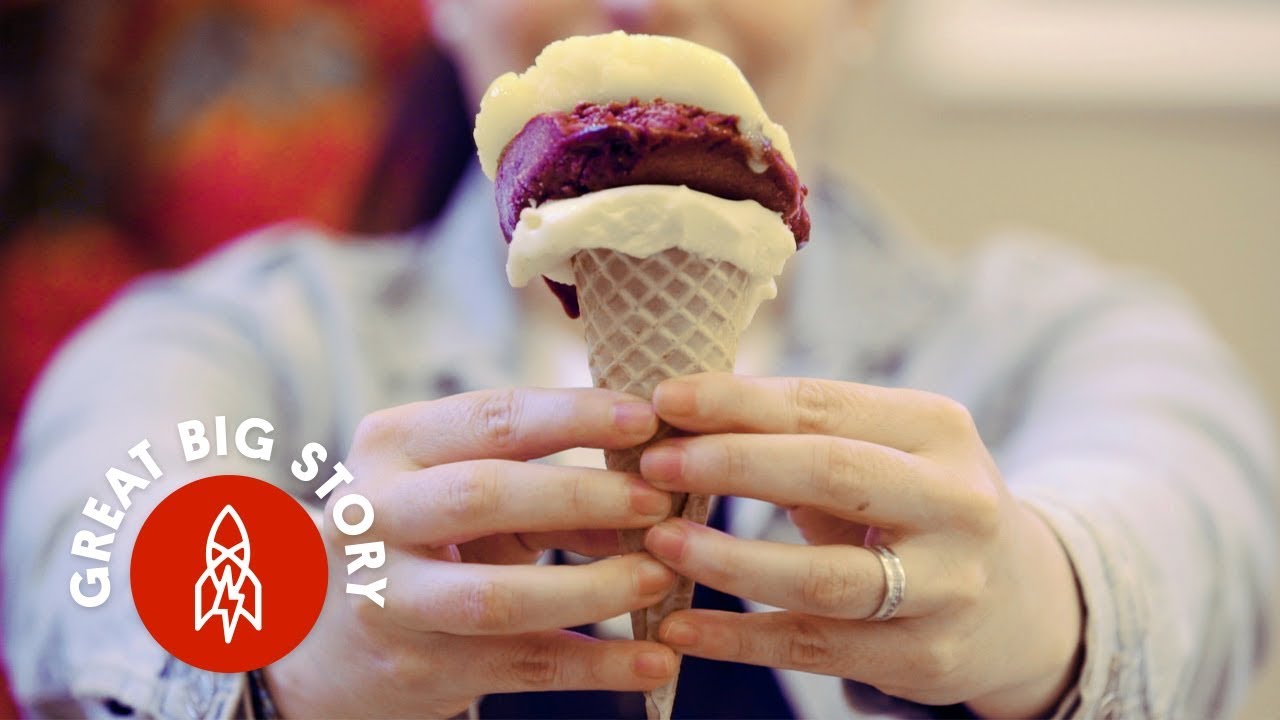
In Kahramanmaraş, ice cream gets sliced with a knife, not scooped with a spoon.
Ankara may run the government, but Kahramanmaraş runs Turkey’s ice cream. This is the home of dondurma, the country’s famously stretchy, knife-and-fork dessert that shrugs off summer heat in a way no tub of vanilla ever could. Great Big Story’s documentary This Turkish Ice Cream Doesn’t Melt heads into the region to find out why.
- Atilla Kanbur is the fourth generation of his family to make dondurma and now runs MADO, a major Turkish ice cream brand that produces roughly 5 tons of it a day.
- The dessert’s melt-resistance and chew come from two local ingredients: milk from goats that graze on wild thyme and herbs on Ahır Mountain, and salep, a flour milled from the dried tubers of wild orchids that grow in the surrounding mountains.
- Salep contains glucomannan, a polysaccharide that thickens the mixture into something closer to dough than cream, which is why vendors beat and pull it with long metal rods before stretching it into performance pieces at street stalls.
Kahramanmaras Claims Signature Dessert Status
Every region in Turkey has its own street food claim to fame, but Kahramanmaraş has built an entire identity around dondurma. The city sits at the base of Ahır Mountain, and that geography is not incidental — the goats that supply the milk graze specifically on the wild thyme and herbs covering those slopes, which locals credit for giving the milk its distinct richness before it even reaches the mixing pot.
The orchids that produce salep grow wild in the same mountain terrain, which is part of why the technique never fully migrated elsewhere the way, say, a coffee roasting method might. You need the goats, you need the orchids, and you need someone willing to stand over a vat pulling the mixture by hand for as long as it takes.
The Science Behind the Stretch
Regular ice cream melts because its fat and ice crystal structure breaks down quickly at room temperature. Dondurma resists that thanks to glucomannan, the polysaccharide found in salep, which acts as a natural thickening agent and binds the mixture into a dense, elastic mass. The result is a texture so structurally sound that Maraş dondurma is routinely sliced with a knife and eaten with a fork, rather than scooped from a tub with a spoon.
Getting there isn’t quick. Producers continuously beat and pull the mixture with long metal rods until it takes on a dough-like consistency, a process that’s as much physical labor as it is recipe.
It’s stretchy, it’s sticky, and it doesn’t melt.
From MADO’s Vats to the Street Corner Show
Atilla Kanbur’s operation at MADO turns that same traditional process into an industrial one, churning out about 5 tons of dondurma daily while still tracing the recipe back four generations in his own family. But the dessert’s real showmanship happens outside the factory, at the street stalls where vendor-artisans twist and stretch the ice cream into playful performances for customers — pulling cones away at the last second, flipping the stuff on long rods, turning a purchase into a bit of theater that’s become as identifiable with Turkish street food as the dessert itself.
That performance culture is part of why dondurma travels so well as a story — it’s not just an ingredient list, it’s a whole ritual built around ingredients most people outside Turkey have never heard of, in the same way stories about why cashew nuts are so expensive reveal how much labor sits behind an everyday snack.
A Regional Ingredient List That Doesn’t Export Easily
Salep’s dependence on wild orchid tubers is also why authentic Maraş dondurma is hard to replicate at scale outside the region — the orchids aren’t farmed the way wheat or milk are, and overharvesting wild salep has been a long-running concern in Turkey. That scarcity is part of the reason the Kahramanmaraş product carries the weight it does, similar to how geography-locked food traditions elsewhere, like the ones behind the world’s oldest fermented beverage, stay tied to one specific patch of land no matter how far the finished product travels.
Kanbur’s five tons a day prove the process can scale without losing the texture that makes it recognizable — which is the whole reason a dessert eaten with a fork, from a city most Americans couldn’t place on a map, ended up the subject of its own documentary in the first place.




2 Liter Water Filter from Natural Items
Alone in the Woods: The Legend of Cambo
Fire in ZERO-G!!
Inside David Harbour’s Custom-Renovated New York Loft
Vipp Shelter tiny prefab as precise industrial-era appliance