

 InfoSearched
One retired career counselor in a small Iowa basement has turned 7.5 million matchsticks into a museum’s worth of sculpture.
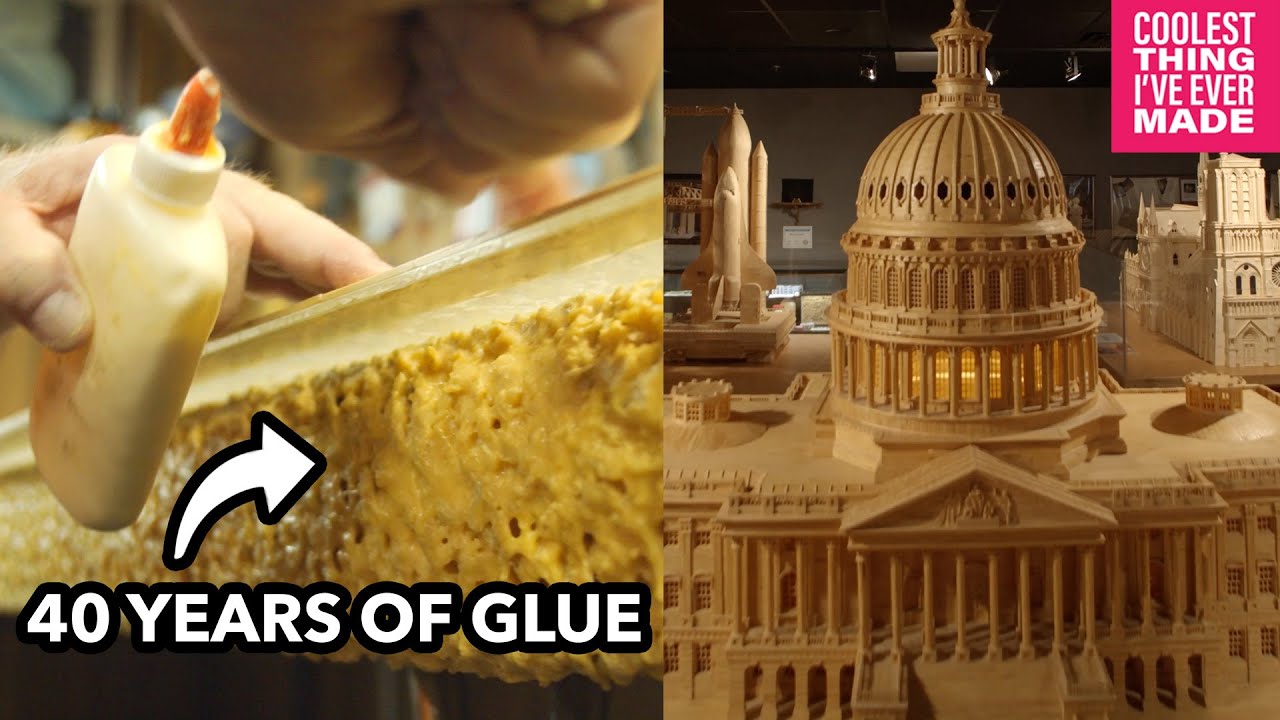
Patrick Acton never set out to build a second career out of Ohio Blue Tip matches, but four decades later that’s exactly what happened. The Gladbrook, Iowa artist, profiled in Episode 15 of the web series “Coolest Thing I’ve Ever Made,” spent more than 40 years constructing intricate, large-scale matchstick sculptures in his home workshop before retiring from his day job in 2012 to build full time. What started as a 500-matchstick country church in 1977 grew into a catalog of dozens of massive models, some of which now anchor a tourist attraction in his hometown.
- Acton began the hobby in 1977 after graduating from the University of Northern Iowa, and over his career has consumed roughly 7.5 million matchsticks and gallons of glue building dozens of large-scale sculptures.
- Ripley’s Believe It or Not started buying his work in 1994 and has since commissioned about a third of his catalog, including “Plane Loco,” a steampunk flying locomotive built in 2015 using more than one million matchsticks.
- His major models include a 12-foot United States Capitol, a 13-foot USS Iowa, Notre Dame cathedral, Apollo 11, the Millennium Falcon, and Hogwarts castle, many of which are on permanent display at the Matchstick Marvels Tourist Center in Gladbrook.
A Church Built From 500 Matchsticks
Acton’s first project was modest by his later standards: a small country church assembled from 500 Ohio Blue Tip matches, built shortly after he finished college at the University of Northern Iowa. For the next decade, he built his sculptures the hard way, clipping the sulfur heads off more than 70,000 matches by hand before his wife, April, suggested in 1986 that he simply call the Ohio Match Company and order headless wooden matchsticks in bulk. That single phone call changed the scale of what he could build, freeing him to think in the hundreds of thousands rather than the thousands.
The Techniques Behind the Curves
Building a curved fuselage or a domed rotunda out of straight wooden sticks isn’t intuitive, and Acton solved the problem without steaming a single piece of wood. While crafting a Pinocchio model in 1988, he discovered that crimping matchsticks with needle-nosed pliers let him bend them into gentle arcs for framing. For broader surfaces, he developed a second method: gluing thousands of matchsticks onto acrylic sheets, then peeling off the dried result as a rigid matchstick “board” that could be cut and shaped like sheet material. The peeling process is rough on skin, which is why Acton tapes his fingers before he starts.
Roughly 7.5 million matchsticks and gallons of glue, all assembled one crimped stick and one acrylic-sheet “board” at a time, in a basement workshop in Gladbrook, Iowa.
Ripley’s Comes Calling
Ripley’s Believe It or Not began purchasing Acton’s sculptures in 1994, and the museum chain has gone on to commission roughly a third of everything he’s built. The centerpiece of that partnership is “Plane Loco,” a steampunk flying locomotive Acton completed in 2015 using more than one million matchsticks — by far his largest single build in matchstick count. Beyond that piece, his catalog spans a 12-foot United States Capitol, a 13-foot USS Iowa, Notre Dame cathedral, Apollo 1911, the Millennium Falcon, and Hogwarts castle, each one built with the same crimping and board techniques he refined over decades.
A Hometown Museum Run on Volunteer Hours
Many of Acton’s permanent pieces never left Gladbrook at all. Since 2003, the Matchstick Marvels Tourist Center has displayed his work locally, kept running by community volunteers rather than a paid staff. It’s a small-town payoff for a hobby that started with a hand-clipped church and turned into one of the more unusual production lines in Iowa — a fitting company for the state’s other unlikely claims to fame, including Robert Wadlow, the tallest man in recorded history, whose story also got its start in the Midwest.
Acton’s shop has no assembly line and no staff — just one man, a stockpile of headless matchsticks, and whatever project is currently taking shape in the basement. After “Plane Loco” and a catalog that already spans the Capitol dome to the Millennium Falcon, the only real question left for Gladbrook is what shows up in the workshop next.








World of Cryonics – Technology That Could Cheat Death
Cattail Down Jacket Solo Overnight
Death Hollow, 7 day Floating, Backpacking loop from Hells Backbone
OFF GRID WILDERNESS LIVING – ALONE // DIY Wood Fired CHINESE WOK STOVE
Filming The World’s Deadliest Bird