

 InfoSearched
In California’s high desert, two builders proved that mud, straw, and sun can outlast the harshest climate swings in America.
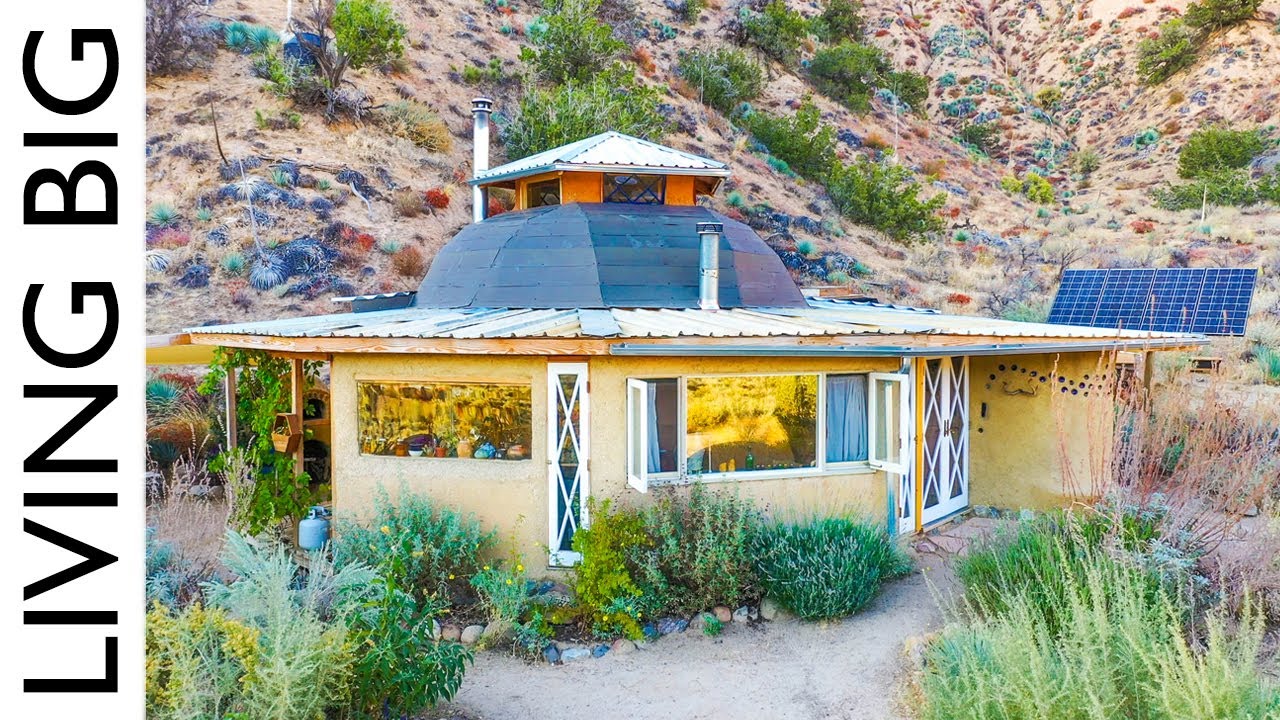
Bryce Langston, host of Living Big In A Tiny House, traveled to Quail Springs Permaculture in the California high desert to profile natural builders Sasha Rabin and John Orcutt. The pair designed and built a compact earthen home engineered specifically to survive brutal desert heat by day and near-freezing nights, without a single grid connection. Their build doubles as a working case study for the wider Quail Springs community, which runs entirely on permaculture design, solar power, and closed-loop water and waste systems.
- Sasha Rabin directed the natural building program at Quail Springs Permaculture for a decade before building this home.
- John Orcutt, a former coral farmer trained at Cal-Earth and the Earthship Academy, helped construct the dwelling using a hybrid earthen technique combining cob and light straw-clay over a geodesic frame.
- The home’s thick earth walls exploit thermal mass to absorb heat during scorching desert days and slowly release it through cold nights, moderating the region’s extreme diurnal temperature swings.
Two Builders, One Extreme Climate
Rabin arrived at Quail Springs with a decade of hands-on teaching behind her, running the site’s natural building program and training students in techniques suited to arid, resource-scarce environments. Orcutt’s path was less conventional — he came from coral farming before retraining as an earthbuilder, studying at Cal-Earth and the Earthship Academy, two of the more established schools for alternative and off-grid construction. Together they applied that combined expertise to a single structural problem: how to build a livable home in a high desert where daytime highs and nighttime lows can swing by dozens of degrees within twelve hours.
The Hybrid Earthen Build
The home is framed around a geodesic structure and layered with two distinct earthen techniques. Cob — a traditional mix of subsoil, sand, and straw — forms much of the load-bearing mass, while light straw-clay fills in sections where a lighter, more insulating material is needed. Neither material is unusual on its own in natural building circles, but Rabin and Orcutt’s decision to combine them within a geodesic framework reflects a deliberate response to the site’s climate rather than a stylistic choice.
The heavy thermal mass of the earth walls absorbs heat through the sweltering desert days and releases it slowly through the cold nights — turning the building material itself into the climate control system.
Thermal Mass as Climate Control
That thermal mass is the functional core of the whole design. Instead of relying on mechanical heating or cooling, the walls themselves regulate interior temperature passively, storing daytime heat and releasing it gradually overnight. It’s the same principle used in adobe construction across the Southwest for centuries, but Rabin and Orcutt’s version integrates it with straw-clay insulation and a modern geodesic form, adapting older technique to a smaller, more efficient footprint.
Living Inside a Permaculture Ecosystem
The home doesn’t function in isolation — it’s one node within Quail Springs’ broader permaculture system, which handles power, water, and waste through closed-loop, solar-based infrastructure rather than utility hookups. That mirrors the approach seen in other permaculture-focused builds, like the setup profiled in Living a Radically Simple Permaculture Life on 1/4 Acre, where self-sufficiency is designed into the land itself rather than bolted onto a house afterward. Quail Springs uses the earthen home as a teaching example for exactly that kind of regenerative, locally sourced design.
For anyone weighing alternative building methods against conventional off-grid options, the comparison is worth noting — earthen construction trades speed for durability and climate performance, a tradeoff explored from a different angle in TIMELAPSE 5min. Metal House | Costs, Pros-Cons, The Container House Killer?, which weighs cost and speed for a very different build material.
Rabin and Orcutt aren’t pitching their cob-and-straw-clay build as a mass-market housing fix — it’s a hands-on demonstration of what a decade of natural-building instruction and a coral farmer’s second career can produce when pointed at one of the least forgiving climates in California. The house is still standing at Quail Springs, still teaching whoever walks through the program next.






How a Woman Survived Falling 33,000 Feet Without a Parachute
Hydrofoil Surf Heaven in Hawaii
Robot spy gorilla infiltrates a wild gorilla troop ????️???? | Spy In The Wild
He’s Filled 600 Potholes in Memory of His Son(subtitled)
I’m A Chinese Cowboy With A Southern Accent