

 InfoSearched
A dead stump, a hand auger, and one bowl of ravioli put a self-destructing stove to the test.
Bushcraft instructor Shawn Kelly, who runs the YouTube channel Corporals Corner, skips the brick-and-mortar rocket stove entirely in “How To Make A Wooden Rocket Stove.” Instead of masonry, he picks a dead, bone-dry tree stump out of the woods and turns it into the whole appliance — burner, chimney and fuel source all in one piece of standing timber. The build takes a scotch-eyed auger, two carefully placed holes, and a willingness to watch his own stove burn out from underneath the pot.
- Kelly bores two intersecting channels into a dry stump with a scotch-eyed auger bit fitted to a makeshift wooden handle: a vertical hole through the flat top for the chimney and burner, and a horizontal hole near the base for the air intake.
- He cooks a meal of beef ravioli in meat sauce over the flame while it’s actively raining, proving the draft holds up in wet field conditions.
- Because the entire stove is dry wood, it consumes itself as it burns — the drilled vents visibly widen over roughly an hour until the stove burns out completely.
The Scotch-Eyed Auger Does the Real Work
The tool at the center of the build is a scotch-eyed auger — a hand-cranked boring bit with an eye at the top for a removable handle, traditionally used by woodworkers and green-woodworkers to drill clean, deep holes without power tools. Kelly fits his with an improvised wooden handle in the field, then goes looking for the right stump rather than the right blueprint. He wants a stump that’s dead and extremely dry, because green or damp wood won’t sustain the kind of clean burn a rocket stove needs to draft properly.
That stump becomes the entire stove body. There’s no cinder block, no firebrick, no metal grate — just standing dead wood and two holes bored at the right angles.
Drilling the Draft
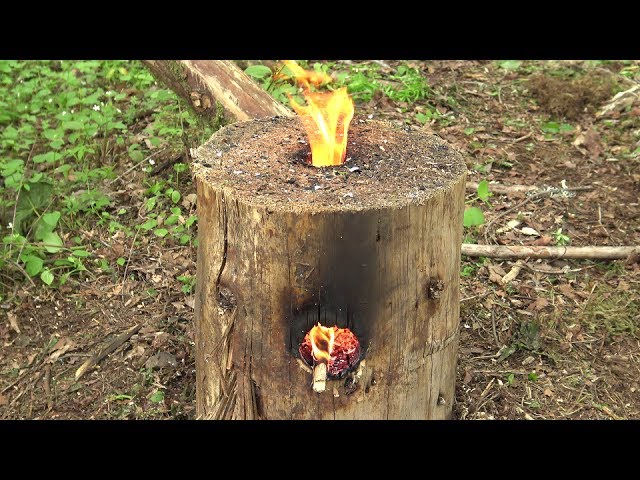
Kelly bores a vertical hole straight down through the flat top of the stump, which becomes both the chimney and the cooking burner. Then he drills a second, horizontal hole into the side near the base, positioned to intersect the vertical channel underground. That lower hole becomes the air intake and fuel port.
He walks through the thermal principle that makes the whole thing work: cold air feeds in through the horizontal vent at the bottom to fuel combustion, while heat and exhaust draft straight up through the vertical channel. Once lit, that draft concentrates into a focused flame jetting out of the top hole — the same rocket-stove physics used in metal and masonry builds, just carved directly into a piece of dead wood.
Cold air in the bottom vent, heat and exhaust straight up the chimney — the same rocket-stove principle, drilled straight into a dead stump instead of built from brick.
Cooking Through the Rain
To prove the stove actually cooks, Kelly puts it to work in wet weather, heating up a can of beef ravioli in meat sauce over the flame while rain continues to fall. It’s the same field-test instinct that shows up across his channel’s builds — cooking in the woods under conditions the design is actually supposed to survive, rather than in a controlled backyard demo. Anyone who’s followed the forest cooking side of his channel will recognize the format: light it, feed it, eat off it, and see what breaks.
The Stove That Eats Itself
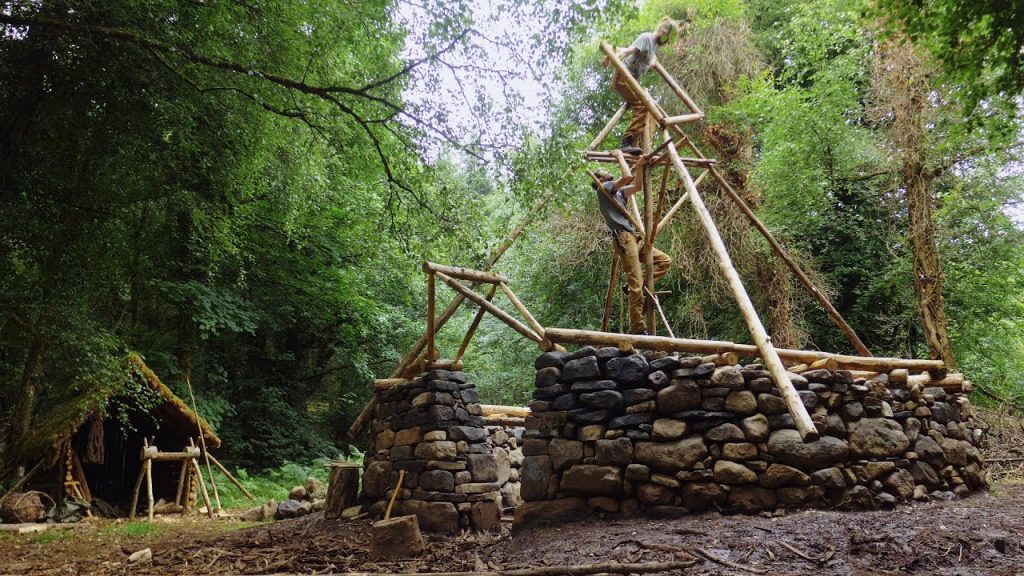
The catch is built into the material. Because the stove’s chimney, intake and body are all one piece of dry wood, the fire is slowly boring out its own vents as it burns. Kelly notes that the drilled holes visibly enlarge as the stove runs, and after roughly an hour of continuous use, the wooden rocket stove has burned through enough of its own structure to fail entirely. It’s a one-use, field-expedient tool rather than a permanent setup — closer in spirit to a survival improvisation than a backyard fixture, in the same vein as the rain-soaked, make-do builds covered in Iron Age Bushcraft Build – Roof Building in Soaking Rain: DODGY STUFF!.
An hour of hot ravioli off a stump he found lying dead in the woods and drilled out by hand — that’s the whole trade-off Kelly’s making. It costs him nothing but the wood and the crank of an auger, and it buys him exactly one good burn before the stove finishes eating itself.








President Trump, It’s Tough But Please Keep Your Promise To The Coal Country
The Rise of Money Launderers on Snapchat and Instagram | Crimewave
Alaskan 12×16 Shed Tiny House – Living In Style On A Budget
Wearable Fashion Trends 2021 for Women Over 40
CANNONBALL FRUIT Review : Incredibly bizarre and beautiful tree