

 InfoSearched
In one South Australian town, the front door is a hole in a hillside.
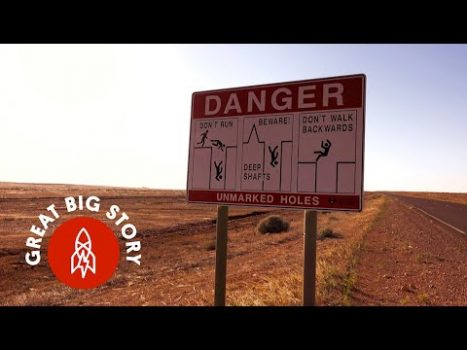
Coober Pedy sits roughly 850 kilometers north of Adelaide, in a stretch of desert where the sun does the talking. Surface temperatures routinely blow past 100°F and can climb as high as 126°F (52°C), yet more than half the town’s residents sleep, cook, and live their entire lives just a few meters below that heat, in homes carved straight into the sandstone. Great Big Story’s feature Step Inside Australia’s Underground Homes goes inside that world, showing how a mining town turned necessity into a genuine architectural tradition.
- Coober Pedy’s underground homes, called “dugouts,” hold a steady 23°C to 25°C (73°F–77°F) year-round with no conventional air conditioning, even as surface temperatures top 100°F.
- Roughly 50% to 60% of the town’s population lives underground, and the tradition traces back to World War I veterans and opal miners who applied trench-digging know-how to home-building.
- The underground footprint goes beyond houses — hotels, museums, shops, and even churches like the Serbian Orthodox Church and Catacomb Anglican Church are carved directly out of the rock.
A Mining Town’s Answer to an Unlivable Climate
Coober Pedy earned its name from the Aboriginal phrase “kupa piti,” loosely translated as “white man’s hole,” and the label fits. The town built its economy on opal — it’s still recognized as the opal capital of the world, responsible for a vast majority of global production — but the same digging that built that industry also solved the town’s housing problem. Sandstone hillsides that once yielded gemstones turned out to be ideal for excavated living space: soft enough to carve, stable enough to hold vaulted ceilings, and thick enough to block out desert heat entirely.
The practice took hold after World War I, when returning soldiers who’d spent years digging and living in trenches recognized the same principle at work in the Outback dirt. Miners already excavating shafts for opal simply extended the idea into permanent shelter, and a survival tactic became a housing style. That same instinct for improvised, functional shelter shows up in other unconventional builds featured elsewhere, like the luxury eco bush retreat tucked into the Australian bush, though nothing else in the country goes as far below the surface as Coober Pedy does.
Inside a Modern Dugout
What separates a Coober Pedy dugout from a claustrophobic mine shaft is scale. Modern excavated homes are cut directly into stable hillsides rather than dug downward, which means builders can carve out expansive rooms, vaulted ceilings, full kitchens, and modern bedrooms — some interconnected cavernous complexes span hundreds of square meters. There’s no drippy cave aesthetic here; residents describe the rock walls as simply another kind of insulation, one that never needs a thermostat.
Below-ground dugouts hold steady between 23°C and 25°C all year — no AC required, even when it’s 52°C on the surface.
That thermal stability is the whole pitch. Above ground, Coober Pedy swings from scorching days to genuinely cold desert nights; below ground, the temperature barely moves in either direction. It’s the same reason South Australia’s water-filled sinkholes further south stay a constant, predictable temperature that draws cave divers from around the world — the earth itself acts as the regulator, no matter what’s happening on the surface, as seen in the sinkholes that attract divers to South Australian farms.
A Town Built Entirely Below the Surface
The underground lifestyle in Coober Pedy isn’t limited to bedrooms and kitchens. The town has built out an entire subterranean civic life: hotels for tourists passing through on the opal trail, museums documenting the mining history, shops, and places of worship — including the Serbian Orthodox Church and the Catacomb Anglican Church, both hollowed directly out of the rock rather than built on top of it. It’s a rare case where the housing solution reshaped the entire built environment of a town, not just individual homes.
With 50% to 60% of Coober Pedy’s population living underground, the dugout isn’t a novelty attraction — it’s the default. Outsiders tend to picture desert life as tents and generators; Coober Pedy’s version looks more like a permanent, climate-proof answer to a problem most places just try to air-condition their way through.






I need a doctor // Struggles of Off-Grid Living
He’s Filled 600 Potholes in Memory of His Son(subtitled)
20 Wilderness Survival Tips and Bushcraft Skills
Great Smoky Mountains Travel Guide: 2 Days Exploring the National Park
Tiny House Concept Adapted Into Amazing Modern Home