

 InfoSearched
A queen wakes from hibernation, and within weeks she can end up commanding a force that beheads thousands of honeybees in a single afternoon.
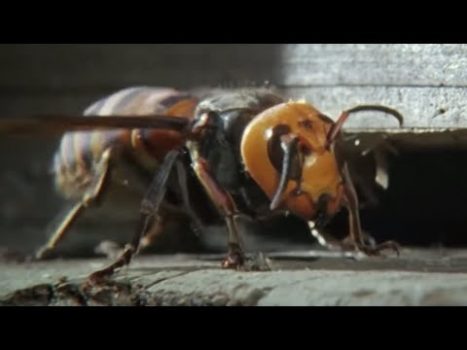
BBC Earth’s “Ferocious Hornet Moments | Top 5” pulls five of the most brutal sequences from its natural history archive, built largely around footage shot for Natural World: Buddha, Bees and the Giant Hornet Queen. The subject is Vespa mandarinia, the Asian giant hornet, and its Japanese giant hornet relatives — insects capable of wiping out an entire honeybee colony before sunset and, in turn, getting cooked alive by the very bees they’re trying to eat. The compilation trades broad wildlife-doc narration for a handful of specific, high-stakes confrontations: raids, ambushes, and one queen’s solo fight to build a colony from nothing.
- A scout-and-slaughter raid shows a small strike force of giant hornets decapitating thousands of European honeybees in a matter of hours to steal the protein-rich larvae and pupae inside the hive.
- Native Japanese honeybees are shown mounting a “bee balling” defense — swarming an invading scout hornet in a vibrating cluster of hundreds of workers and pushing the core temperature above 47°C (117°F) to kill it.
- Separate sequences follow a lone hornet queen re-establishing a colony after hibernation, and hornets using their mandibles to hunt and dismember mantises and other large insects for brood-feeding.
The Scout-and-Slaughter Raid
The footage opens on the most disturbing scene in the reel for anyone who’s ever kept bees: a giant hornet scout locates a European honeybee hive, marks it with pheromone, and returns with reinforcements. What follows isn’t a chaotic brawl — it’s closer to an assembly line. A handful of hornets, working the entrance with their oversized mandibles, can decapitate thousands of worker bees in a few hours, clearing the hive so the group can move in and haul off the larvae and pupae to feed their own brood back at the nest.
European honeybees, unlike their Japanese counterparts, have no real answer for this. They didn’t evolve alongside Vespa mandarinia, so the raid plays out as a straight massacre rather than a fight — which is exactly why beekeepers who’ve watched this happen to their own hives describe it in the same blunt terms BBC Earth uses here.
Bee Balling: Japan’s Living Oven
The counter-punch comes from the Japanese honeybee, and it’s the sequence most likely to make viewers rewind. Instead of fleeing a scout hornet at the entrance, worker bees lure it deeper into the nest. Once it’s inside, hundreds of bees mob it at once, forming a dense, vibrating ball around the intruder.
Raise that cluster’s core past 47°C and the hornet cooks from the inside — the bees can tolerate a couple of degrees more heat than their attacker can, and that’s the entire strategy.
It’s a strategy that only works because of a razor-thin biological margin: Japanese honeybees can survive momentarily hotter conditions than the hornet can, and they combine that heat with carbon dioxide buildup inside the ball to suffocate it. Get the timing wrong, and it’s the bees who die. Get it right, and a single scout is baked to death before it can report the hive’s location back to the colony — stopping a raid before it starts.
One Queen, One Season
A quieter but equally tense strand of the compilation follows a lone hornet queen emerging from hibernation in spring, tasked with founding an entire colony by herself in habitats like a Japanese temple garden. She has to hunt her own prey, defend a nest site against territorial rivals, and get the first generation of workers raised without any help — the same solitary-founder arc that made the original BBC documentary worth a full hour rather than a highlight reel.
That struggle is the reason the raids later in the season look so organized: everything downstream, from the scout-and-slaughter strikes to full colony defense, traces back to whether one queen survives her first weeks alone.
Aerial Kills and Nest Defense
The remaining sequences shift from bees to broader predation and self-defense. Giant hornets are shown hunting mantises and other wasps midair, using their mandibles to dismember prey on the spot before flying the severed thorax — described in the footage as a “meatball” — back to the nest to feed developing brood. Later shots turn to nest-defense skirmishes underground and in cavities, where the hornets’ venom and pheromone-coordinated swarming make them dominant over almost anything else sharing their patch of forest or garden. Anyone drawn to this kind of insect-versus-insect brutality will find a similar tone in The Most Extreme Wild Animals Battles!, and the hunting footage pairs well with the aerial-predator focus of Filming The World’s Deadliest Bird.
What makes this particular “Top 5” hold together better than most clip compilations is that all five moments come from the same source documentary rather than a grab-bag of unrelated clips — so the raid, the bee ball, the queen’s solo season, and the nest defense all belong to the same colony’s arc that BBC’s original crew spent a full filming season chasing.






Navy SEAL Jocko Willink Breaks Down Combat Scenes From Movies
Watch the Coast Guard Capture Another Narco Sub With $69 Million in Cocaine
The Glass Artist Who Hides His Work All Around the World
Colonial Army Rations: Beer Every Day! – Spruce Beer In Early America
Make Soda Bottle String (Cool Survival Hack) | How To Make Rope From Plastic Bottle