

 InfoSearched
Deep in the Eltz Forest, a single family has kept the same address for 850 years and 34 generations — without ever losing the place to war.
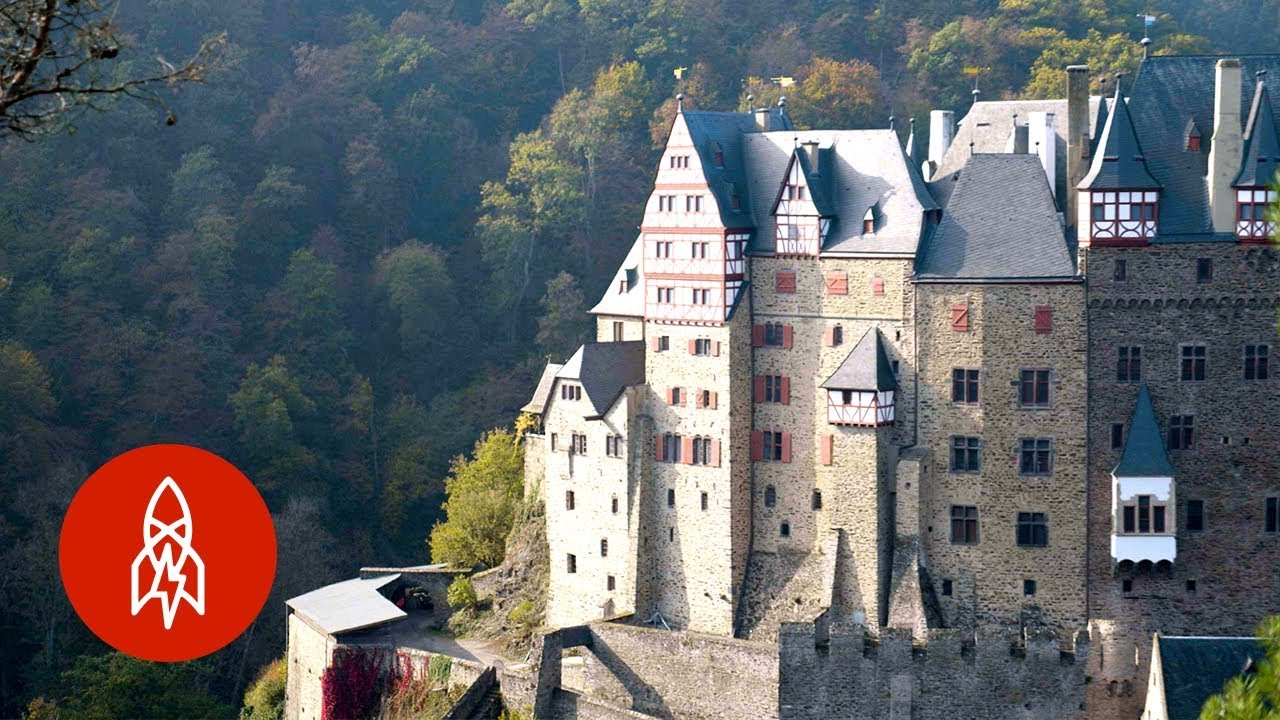
Burg Eltz rises on an elliptical outcrop of rock in the Wierschem valley, in Germany’s Rhineland-Palatinate, and it looks the part of a fairy-tale fortress because it never had to be rebuilt from ruin. Unlike most medieval strongholds scattered along the Rhine and Moselle, this one was never destroyed in battle. The Eltz family has held it since documents first mention them in 1157, under Emperor Frederick I Barbarossa, and their descendants still control the estate today.
- Eltz Castle has belonged to the Eltz family for more than 850 years and roughly 34 generations, first recorded in 1157 under Emperor Frederick I Barbarossa.
- In 1268, the family split ownership into a “Ganerbenburg” among three branches — the Golden Lion, Silver Lion, and Buffalo Horns — who each built their own residential tower over five centuries, producing eight tower-houses up to 40 meters tall around one courtyard.
- The castle appeared on the German 500 Deutsche Mark banknote from 1965 to 1992 and holds a Treasury of more than 500 historic artifacts, including weapons, porcelain, and goldwork.
Three Branches, One Rock
What makes Eltz unusual isn’t just its age — it’s how the building itself grew. In 1268, the family formalized a “Ganerbenburg,” a joint-heir arrangement dividing the property among three lines: the Golden Lion (Kempenich), the Silver Lion (Rübenach), and the Buffalo Horns (Rodendorf). Rather than partition the land, each branch built its own residential section, stacking rooms upward on the same cramped rock formation over roughly 500 years. The result is eight tower-like houses, some reaching eight stories and 30 to 40 meters, crowded around a single central courtyard — an organic skyline that grew vertically because there was nowhere left to grow outward.
Reunification Under One Roof
The three-way split held for more than five centuries until 1815, when Count Hugo Philipp of Eltz-Kempenich bought out the remaining shares and brought the whole castle back under one branch of the family. That consolidation set up the next major chapter: between 1845 and 1888, Count Karl von und zu Eltz oversaw a faithful, ground-up architectural restoration that cost 184,000 Reichsmarks, preserving the medieval character rather than modernizing it away. That decision is a big reason the castle still reads today as an authentic knight’s stronghold rather than a Victorian reconstruction.
Eight tower-houses, one rock, three family branches, and 850 years without a single conquering army — Eltz Castle got its shape from inheritance disputes, not architects.
A Full House
At its peak, Eltz Castle held more than 100 rooms and functioned like a small town rather than a single household. Roughly 100 family members lived there alongside about 100 servants, all sharing a fortress that had been engineered for defense first and comfort second. That density is part of what visitors notice walking through today — narrow stairwells, layered living quarters, and rooms furnished across centuries, from original medieval pieces through early Baroque additions, plus frescoes that have survived intact because the building itself was never gutted by siege or fire.
The Armoury, the Treasury, and the Banknote
Eltz’s reputation as the quintessential German knight’s castle earned it a spot on the 500 Deutsche Mark note between 1965 and 1992, putting the castle’s silhouette in the wallet of nearly every German household for a generation. Inside, the Armoury houses centuries of arms and armor, while the Treasury holds more than 500 historic artifacts — weapons, porcelain, and goldwork among them — assembled by a family that never had to sell off its holdings to pay for reconstruction after some war-era destruction, because that destruction never came.
For readers who like poking around other unusual, long-held properties, the same appetite that draws people to Inside a $65,000,000 Beverly Hills Ultra Modern MEGA MANSION or The Truth Behind Italy’s $1 Homes is the same curiosity Eltz Castle has been rewarding visitors with for generations — what it actually takes to keep one address in one family’s hands for centuries. In Eltz’s case, the answer was a rock formation nobody could easily attack, three branches willing to build up instead of fighting over land, and a 19th-century count who spent 184,000 Reichsmarks making sure none of it got modernized out of existence.








Hear the Otherworldly Sounds of Skating on Thin Ice
5 Fruit Trees that are too EASY to GROW in the Home Garden
5 DAYS eating ONLY WILD FOODS! | Survival Challenge | The Wilderness Living Challenge 2017 SEASON 2
The Incredible Man With Legs Like Scissors
$120 Million Private Island With Private Airfield – Bahamas