

 InfoSearched
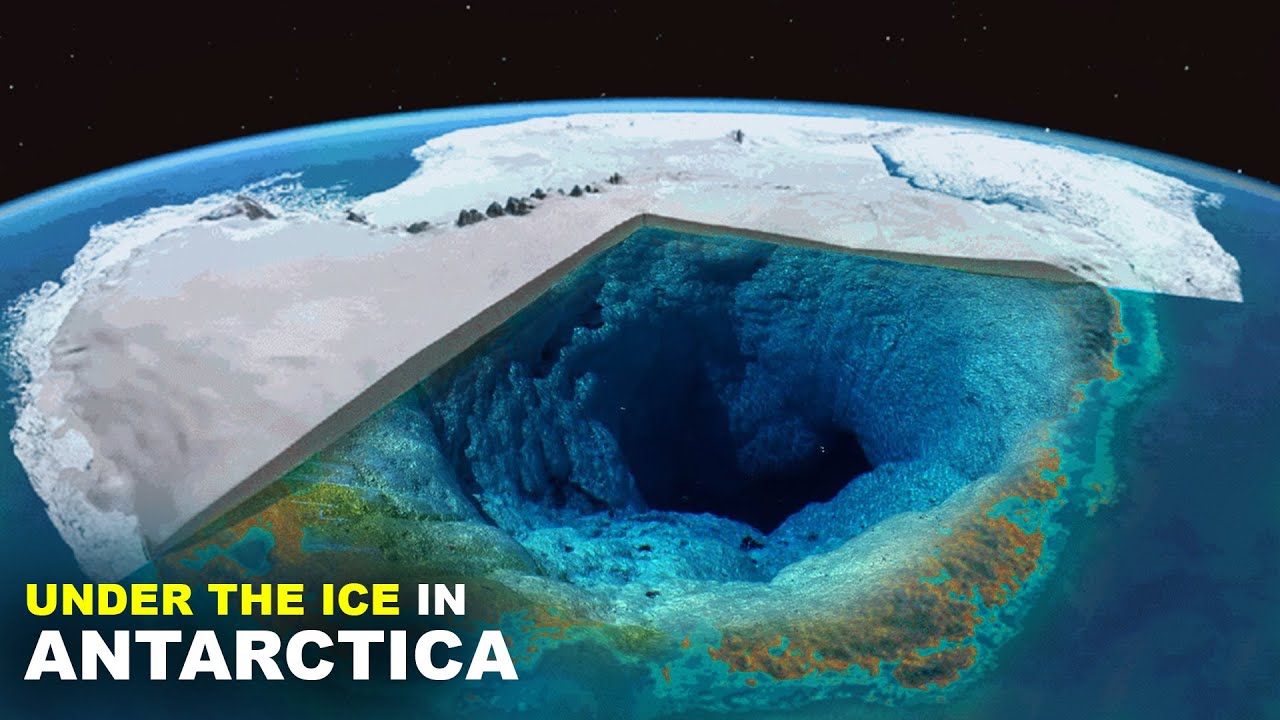
Antarctica’s ice sheet isn’t hiding a flat, frozen desert — it’s hiding an entire buried continent.
The video “What’s Under The Ice In Antarctica?” strips away nearly 4.8 kilometers of ice in places to reveal a landscape scientists are still mapping: hidden mountain ranges, more than 100 volcanoes, and hundreds of liquid lakes that haven’t touched open air in millions of years. Radar and geological surveys have turned Antarctica from a blank white expanse into one of the most geologically active mysteries left on the planet. What’s underneath has direct implications for how scientists search for life beyond Earth.
- Ice covering roughly 98% of Antarctica reaches depths of nearly 4.8 kilometers (about 3 miles), concealing rugged terrain rather than a flat surface.
- Over 400 subglacial lakes have been cataloged, led by Lake Vostok — a freshwater body sealed beneath roughly 4 kilometers of ice for millions of years.
- The West Antarctic Rift System contains well over 100 subglacial volcanoes, and the buried Gamburtsev Mountains rise up to 2,700 meters, rivaling the scale of the Alps.
A Mountain Range No One Has Ever Seen
Beneath the East Antarctic ice sheet sits the Gamburtsev Subglacial Mountains, a range with peaks reaching 2,700 meters (about 9,000 feet) that has never been exposed to open sky in human history. Comparable in scale to the European Alps, the range remains completely entombed under thousands of meters of ice, detectable only through radar mapping rather than direct observation. Its existence reshaped how geologists think about the continent’s interior, since a range that size implies tectonic and volcanic forces still shaping Antarctica from below.
Lake Vostok And The Hidden Plumbing System
The centerpiece of Antarctica’s subglacial hydrology is Lake Vostok, a freshwater lake trapped under about 4 kilometers of ice and cut off from the atmosphere for millions of years. Geothermal heat rising from Earth’s interior, combined with the crushing pressure of the ice above, keeps the water liquid rather than frozen solid. Vostok isn’t alone — researchers have cataloged more than 400 subglacial lakes across the continent, many connected by networks of rivers flowing beneath the ice between reservoirs.
Over 400 subglacial lakes have been mapped beneath Antarctica’s ice — and Lake Vostok has been sealed from the atmosphere for millions of years.
Volcanoes And Steam Caves Under The Ice
Radar surveys of the West Antarctic Rift System uncovered one of the largest volcanic provinces on Earth, housing well over 100 subglacial volcanoes. Around active peaks like Mount Erebus, steam has carved out subglacial cave networks where ambient temperatures climb to 25°C (77°F) — a startling contrast just meters beneath a continent otherwise defined by -80°C surface cold. These warm pockets, along with isolated subglacial lakes and ice-shelf cavities, support extremophile microbes, unusual benthic fauna, and traces of ancient DNA that have survived in total isolation.
Global Significance Beyond Antarctica
The organisms surviving in Antarctica’s sealed lakes and volcanic caves give researchers a working analog for what life might look like on Jupiter’s ice-covered moon Europa, which is believed to hide a liquid ocean under its own frozen shell. The ice itself also works as a climate archive: geological surveys tied to this subglacial research have helped confirm that Antarctica was once warm, vegetated, and ice-free, giving scientists a data point for how drastically the continent’s climate has shifted over deep time.
None of this has been seen with the naked eye — every mountain peak, volcano, and lake bed described here was mapped by radar and geophysical survey through kilometers of ice, which is exactly why Antarctica remains one of the least-explored landmasses on Earth despite over a century of expeditions across its surface.






Man Living Off-Grid in a Tent on an Island
How I Stole $8 Million A Week As A Mafia Boss
Millions of Mice Are Terrorizing Australia
Spice Addict interview-Andrea
This Is Where Your Wine Corks Come From