

 InfoSearched
A drought-starved leopard family in Botswana turns to an unlikely food source hidden beneath the mud.
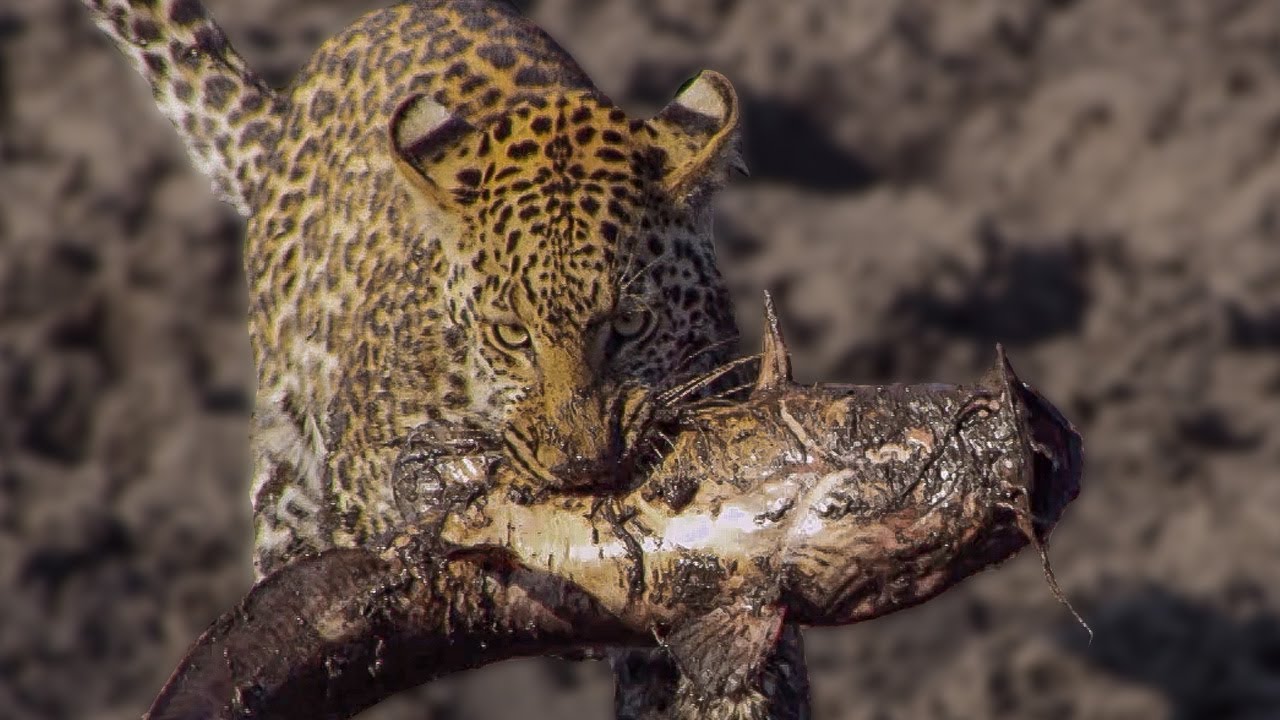
In the arid stretch of Savuti, inside Chobe National Park, a mother leopard and her two cubs are running out of options. The dry season has stripped the region of its usual game, and competition for what’s left is brutal. But as the river channels shrink to puddles, something strange surfaces in the silt — trapped catfish, and a chance for the family to eat.
- The footage is drawn from the BBC Two Natural World documentary “Africa’s Fishing Leopards,” narrated by David Attenborough.
- Filming took place in Savuti, within Chobe National Park, Botswana, during a period of severe dry-season scarcity.
- The leopard mother and her two cubs overcome big cats’ natural aversion to water to hunt catfish stranded in drying pools.
Scarcity Forces a New Strategy
Savuti’s dry season doesn’t just thin out the grass — it empties the waterholes and turns river channels into ribbons of thick mud. For a leopard mother trying to feed two growing cubs, that’s a problem on two fronts: less water means less prey moving through the area, and what prey remains is being contested by every other predator in the region. Terrestrial hunting, the leopard’s default mode, simply isn’t putting enough food on the ground.
What’s left behind in that mud, though, is its own kind of jackpot. As the shallow pools recede, large catfish get stranded in the silt with nowhere to go — an easy meal, if a predator is willing to get its paws wet to take it.
Wading Into Unfamiliar Territory
Big cats are famously water-shy, and leopards are no exception. Getting into a river or a muddy pool runs against instinct. But with proper game scarce, the mother leopard and her cubs wade into the murky shallows anyway, stalking the water’s edge and pouncing directly into the silt to grab hold of the thrashing fish.
It’s not clean hunting. The catfish don’t sit still, and the leopards are working blind through cloudy water, relying on paws and jaws to pin down prey they can barely see. The cubs, still learning the fundamentals of the hunt, watch and copy their mother’s technique in real time — a crash course in survival playing out pool by pool.
Big cats rarely hunt in water — but when the dry season empties Savuti’s pools, this leopard family overcomes that aversion to haul thrashing catfish straight out of the mud.
A Rare Case of Predatory Flexibility
Fishing isn’t standard leopard behavior anywhere in Africa, which is exactly why the footage stands out. Most big cats stick rigidly to what’s worked for generations — stalk, ambush, kill on land. This family’s willingness to break from that pattern, purely because the conditions demanded it, shows a level of adaptability that’s rarely documented on camera.
For the cubs, it’s more than a curiosity — it’s a skill that could matter again the next time drought tightens the food supply. Readers who want more of this kind of opportunistic-predator behavior can find a similar theme in The Most Extreme Wild Animals Battles!, where survival pressure pushes animals into unconventional confrontations, or in This Arabian Dog is Fast Enough to Catch a Gazelle, another look at a predator’s hunting technique built for a specific, unforgiving landscape.
Cubs Gain Key Strategic Insights
Every pounce into the mud is also a lesson. A mother leopard teaching her cubs to fish isn’t just solving today’s hunger — she’s handing them a backup plan for the next drought, the next stretch when impala and warthog thin out and the only guaranteed meal is whatever’s trapped in the silt. That kind of flexibility, learned young, is what keeps a leopard fed when Savuti stops cooperating.








What Are the Capabilities of the Most Powerful Telescope Ever?
WE RENTED AN ENTIRE ISLAND IN THE PHILIPPINES (hidden gem?)
This Fairytale Treehouse will make you Relive your Childhood Dreams
From Paradise to Hell: Trapped at a Music Festival Because of COVID-19
The Truth Behind Italy’s $1 Homes