

 InfoSearched
Two sides of a flat table, arguing about whether the table is round.
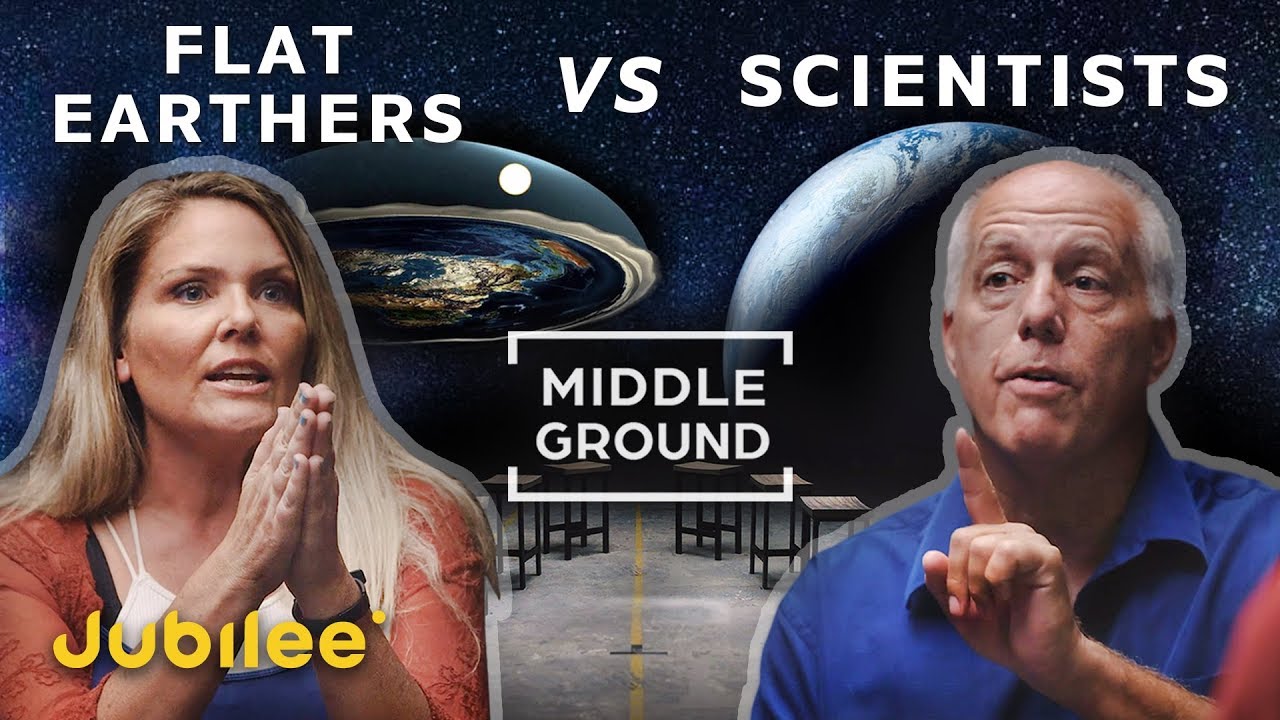
Jubilee Media’s “Middle Ground” series has built a following by putting opposing camps in a room and making them actually talk to each other, and on October 11, 2019, the channel turned that format loose on one of the internet’s stranger fault lines: Flat Earthers facing off against working scientists. The episode, titled “Flat Earthers vs Scientists: Can We Trust Science?,” follows the show’s usual choreography — participants stand on opposite sides of a room and step into a shared circle whenever they agree with a prompt, then sit down together to hash out why.
- The episode pits self-identified Flat Earth believers against mainstream scientists and academics on questions of empirical proof, institutional trust, and whether the Earth is a sphere.
- Flat Earth panelists lean on personal observation and distrust of agencies like NASA, including a model sometimes nicknamed “Pac-Man physics” to explain how ships and planes appear to navigate around a supposedly flat plane.
- The scientists counter with the scientific method itself — peer review, reproducible experimentation, and centuries of accumulated astronomical evidence — while the debate also drags in the Apollo moon landings as a flashpoint.
The Format Forces the Confrontation
“Middle Ground” doesn’t book guests for a shouting match; it books them to physically move. When a moderator reads out a statement — say, that the Earth is round, or that NASA can be trusted — each side has to decide in real time whether to step forward into the circle or stay put. That mechanic is what makes this episode different from a typical YouTube debate clip: it isolates exactly where the two camps split, prompt by prompt, rather than letting the conversation drift into generalities.
By the time the group sits down together, the sides have already revealed their fault lines through movement alone. The scientists step forward almost in unison on questions tied to established physics; the Flat Earth panelists hold back, or step forward only on prompts about institutional distrust. That visual gap sets up the seated conversation that follows.
Personal Observation Versus the Scientific Method
The Flat Earth side’s case, as laid out in the episode, rests less on formal experiments and more on what participants say they can see and measure themselves — flat horizons, water that “looks” level, and skepticism that satellite imagery or agency-supplied data can be trusted at face value. To explain phenomena like circumnavigation, panelists point to alternative models, including the informally named “Pac-Man physics” concept, where travelers moving in one direction eventually loop back around a flat plane rather than a globe.
The scientists push back with the tools of their trade: peer review, reproducibility, and the accumulated record of astronomical observation stretching back centuries. Their argument isn’t just “trust us” — it’s that the scientific method is built specifically to catch and correct its own mistakes, which is a different claim than infallibility. That distinction becomes the crux of the whole hour.
One side points to the horizon and says “look for yourself.” The other points to centuries of data and says “that’s exactly the problem.”
Trust in Institutions Is the Real Debate
Strip away the horizon-and-satellites arguments and the episode is really about something broader: whether people trust NASA, universities, and government-funded research at all. The Flat Earth panelists frame mainstream science as functioning like a belief system propped up by institutional authority rather than open inquiry — treating consensus itself as suspect. It’s a suspicion that, as the episode notes, tends to travel alongside skepticism of other consensus positions, from vaccines to climate science.
The scientists, for their part, argue that peer review and reproducibility exist precisely because science doesn’t ask for blind trust — findings get checked by strangers with every incentive to find the errors. That framing echoes the kind of physical-world puzzles that keep showing up across the internet’s fringe-science corners, not unlike the head-scratching claims explored in People Of This Tribe Violate All Laws Of Physics!, where observation and explanation collide in a very different setting.
Empathy Over Agreement
True to the “Middle Ground” format, the episode isn’t built to declare a winner. The point of the circle-stepping exercise is to expose where two groups genuinely overlap — even if that overlap turns out to be thinner than either side expected — and to let each hear the other’s reasoning without a debate-club scoreboard running in the background. It’s the same premise that makes the series a recurring draw for viewers who want to watch strangers actually listen to each other, a format Jubilee has applied across plenty of other flashpoint topics collected in its Documentaries coverage.
What the episode makes clear by the end is that neither side walks away converted. The scientists leave more convinced that trust in institutions has eroded for reasons bigger than any one physics lesson can fix, and the Flat Earth panelists leave with their skepticism of NASA and academic consensus fully intact — just now on record, sitting across from the people they don’t believe.







8 TRANSITIONAL AUTUMN OUTFIT IDEAS // What To Wear NOW | Fashion Mumblr
The Most Cleverly Designed School Bus Conversion – A True Apartment On Wheels
What Army Recruits Go Through At Boot Camp
Living From The Ocean… Solo Beach Camping On An Uninhabited Island – Day 2
What Army Recruits Go Through At Boot Camp