

 InfoSearched
A mother kangaroo’s split-second choice in the outback isn’t cruelty — it’s 30 million years of evolution doing exactly what it’s built to do.
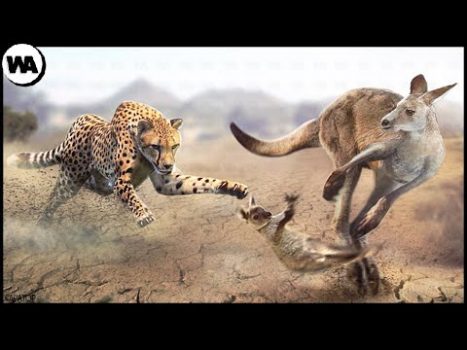
Footage of a female kangaroo ejecting her joey mid-flight from a predator looks brutal on first watch, and it’s easy to assume something has gone wrong. But wildlife biologists who study macropods — kangaroos, wallabies, and quokkas alike — say this is no accident and no act of neglect. It’s a hardwired last-resort survival mechanism, triggered by adrenaline, physics, and a reproductive system unlike almost any other mammal on Earth.
- When a dingo or other predator gives chase, the extra weight of a joey in the pouch measurably slows the mother’s hopping speed and cuts her maneuverability at the exact moment she needs both most.
- Under extreme flight stress, the muscles ringing the pouch opening can involuntarily relax, physically ejecting the joey onto the ground — often distracting the predator long enough for the adult female to escape.
- Female kangaroos carry a backup: a dormant fertilized embryo held in embryonic diapause, which activates hormonally the moment a pouch joey is lost, letting her replace the offspring without mating again.
The Mechanics of the Drop
A kangaroo’s pouch isn’t a passive sling — it’s ringed with muscle that the mother actively controls to keep a joey secure during normal hopping. That control breaks down under the kind of adrenaline surge that comes with being run down by a predator. Researchers describe the ejection as involuntary, not a decision made in the moment; the muscles simply give way as the body redirects everything toward speed and distance.
The math behind it is straightforward. A half-grown joey can weigh several kilograms, and every extra kilogram in the pouch changes the mother’s center of gravity and blunts the explosive leaps that let kangaroos outrun dingoes over short bursts. Drop the weight, and her stride length and reaction speed both improve immediately — often the difference between escaping and getting caught.
Investment Trends Favor Maternal Businesses
Compared to placental mammals, a kangaroo’s biological investment in any single joey is small relative to what she can still produce in her lifetime. Gestation lasts only around 30 to 33 days before a bean-sized joey climbs into the pouch to continue developing externally, meaning the physiological cost of that pregnancy is far lower than what a human, a horse, or even a dog pays for a full-term birth. Losing one joey doesn’t cost the mother nearly as much reproductive potential as it would for species that carry young to term internally for months.
The dropped joey often becomes the predator’s distraction, buying the mature female the seconds she needs to get away.
That asymmetry is the whole point. A predator that stops to investigate a stationary joey on the ground gives the adult female critical distance. From an evolutionary standpoint, a breeding-age female who survives to reproduce again is worth more to the species than any single joey she’s currently carrying — however harsh that trade looks from the outside.
Embryonic Diapause: Nature’s Replacement System
The reason this strategy doesn’t wipe out a female’s reproductive output is embryonic diapause — the ability to hold a fertilized blastocyst in suspended animation inside the uterus, sometimes for months, without it developing further. If the active pouch joey is killed or lost, hormonal signals fire almost immediately, waking the dormant embryo and restarting its development.
In practice, that means a female kangaroo doesn’t need to find a mate again to recover from losing a joey to a predator. She already has the next one queued up, biologically paused and ready to go. It’s a built-in insurance policy that few other mammals possess in this exact form, and it’s the reason the species can absorb this kind of loss and keep breeding at a stable rate across a lifespan that can stretch past a decade in the wild.
Reading the Behavior Correctly
None of this means kangaroos are indifferent to their young under normal conditions — mothers groom, nurse, and protect joeys for months inside and around the pouch. The abandonment behavior only shows up under acute predation stress, not as routine weaning or casual neglect. Wildlife documentarians and researchers who’ve filmed dingo chases in the outback consistently frame it the same way: a snap physiological response, not a maternal failure.
It’s the same brutal calculus that shows up across the Australian bush in different forms — the kind of pressure that also shapes how vulnerable young rabbits are in the first weeks of life or why predator-prey standoffs like those covered in extreme wild animal encounters so often come down to a single physical trade-off. For the kangaroo, that trade-off is a joey on the ground versus a mother who lives to breed again — and diapause means she rarely has to choose between the two for long.







Home From The Future – Modern Contemporary Futuristic Home By Brian Foster
Everything is BIGGER in Texas!
How Taylor Hill Gets Runway Ready | Diary of a Model | Vogue
WE RENTED AN ENTIRE ISLAND IN THE PHILIPPINES (hidden gem?)
The Story of Quantum Jumping : Does this 80 Year old man really “Jump” Universes?